Showing posts with label Nissan LEAF. Show all posts

Monday, April 21, 2014

BMW i3 Selected the Best Green Car of 2014 by Kelly Blue Book


The awards keep piling up for the BMW i3. Less than a week from winning the 2014 World Green Car and the 2014 World Car Design Of The Year, Kelly Blue Book just awarded the 2014 BMW i3 the "Best Green Car of 2014".

The Nissan LEAF finished second  with the Toyota Prius third. Four of the top six cars were either all electric or PHEV's. Here's how the top ten placed:


Monday, April 7, 2014

BMW i3 Training Autocross Video


*Hat tip to insideevs.com for finding this first!


BMW has been holding i3 training events to get the new BMW Product Geniuses up to speed on what they need to know about the car. As I have written here many times, there is so much about this car that is completely different than anything BMW has ever sold before that they really need to dive deep into the training of their client advisers and especially these new Product Geniuses. As good as the car is, if they fail to have the ability to properly help the customer decide if the car is right for them, then they won't sell nearly as many as they could have. This is going to have to play itself out before we can gauge if BMW did indeed do everything they could have to give the dealers the tools they need to sell these vehicles.

However in my opinion this video is promising. Not only is BMW holding training sessions where the Product Geniuses will learn about he cars, but they are getting the chance to take once out and do an autocrossing session in one. Plus, in addition to getting to drive in the i3, they also get to drive in a couple i3 competitors, like Chevy Volts and Nissan LEAFs while they are there so they can see how much better the i3 performs.

I assume the above video was taken by one of the Product Geniuses during one of the training sessions and posted on YouTube. It's not a professional quality video by any means, but it does show he was indeed impressed with the i3's performance.  


Wednesday, March 12, 2014

Comprehensive i3 Video Review By Nissan LEAF Owner in the UK


It seems that nearly every day now there are new short video clips of i3 reviews posted on YouTube. When I come across one that I feel is done very well, I'll post it here. Such is the case with the above video made by Grant Thomas from the UK. Grant maintains a blog called "The Grant Thomas Blog: Sustainability, Electric Cars & Technology News and Comment" where he posted this i3 video review.

Grant owns a Nissan LEAF so he is an experienced electric vehicle owner and in my opinion that gives his review a little more credibility than some others done by journalists with very little real life electric vehicle experience. The video is about a half hour long and he does manage to cover a lot so pour yourself a nice cup of coffee (or a glass of wine), and kick back and enjoy!

Friday, February 21, 2014

BMW i3 Production Delays Reported

Virtually every facet of the i3's manufacturing process is different and BMW is evidently struggling to manage setbacks
According to Jay Cole over at insideevs.com i3 production is currently 50% lower than expected at this point in time. Cole's source is Manager Magazine Online, a German Publication, which states the high rejection rate of the carbon fiber parts made for the car. The article goes on to say that BMW's recent announcement that the company will be investing another 100 million euros to increase the production of carbon fiber is tied to this issue.

Manager also says BMW is only churning out 70 i3's per day which is about half of what they were hoping to be making by now. BMW began i3 production in October so they are four months in and now have over 11,000 i3's on backorder. Plus, US sales are only just beginning so it would appear that even if BMW gets the current problems solved in short order (and that's a big "if"), it will still probably take them nearly a year to catch up with demand since the orders will continue to pile up. It has long been speculated that BMW will have the capacity to make between 30,000 and 40,000 i3's per year once they are running at full production.

It seems we now have some answers to two things which were puzzling US customers recently. A couple months ago BMW announced that US i3's will not have a moonroof available. This comes long after it was announced that the i3's with Giga World and Tera World interiors get the moonroof included with the packages. To make matters worse, most of the i3's here in the US are pre-production European spec cars and they all have sunroofs. So everyone that had the opportunity to test drive an i3 got teased with seeing the moonroof that they were later told they won't be able to have. Then, a few weeks ago BMW announced the first three months of i3 US production would be limited to a "Launch Edition" version. The Launch Edition is fully loaded with every option available on the car and the most expensive Tera World interior. The only thing the customer can choose is the color (and only the metallic colors are available) and if they want the optional 20" sport wheels.

Many people speculated that is was simply a money grab and BMW knew the car would be in high demand so they could get away with making anyone that wanted one of the first i3's in the US buy one that was loaded. Now, with the recent news about production difficulty, I think it's obvious the reasons the moonroof isn't available at launch, and custom ordering isn't available for another three months, is solely because BMW is struggling to refine the manufacturing process and eliminate the problems they are currently having.

I've had the opportunity to talk with many BMW program managers over the past few years. One of the things that has always stood out to me was how on one hand they were really excited about the i3 because of how special and different everything about it is, while on the other hand they would always acknowledge how big a challenge it was going to be. Everything about the i3 is different. BMW has never made a car that required special manufacturing processes for virtually every stage of assembly. Besides the electric powertrain, most of the materials used in the car are even different. While the biggest challenge is likely working with carbon fiber on such a large scale, they are also using more aluminum on a car than they ever have and are using interior materials that they have never worked with before. Then there is the outer thermoplastic body panels which BMW has never used before which has even led to the painting process presenting challenges.

So personally I'm really not surprised by all this. The i3 is a revolutionary new car for BMW, and nobody else is making anything quite like it. Yes, there are some that will look at it and say "It's just another 80 mile electric car, big deal", or "It's nothing more than a Nissan LEAF that costs $50,000". I respect everyone's opinions, and for some people it doesn't represent any more value than a $30,000 Nissan LEAF and that's fine. However when I see the i3 I see the future of the automotive industry and I applaud BMW for taking the enormous risk of building such a radically different car, something that nobody else is attempting to build. Yes, I wish it had more range and I think BMW would have been better served if it could really deliver 100 miles of consistent real world range for most drivers, and it's clear it will not. But that's the biggest knock I can offer and it's far from a deal breaker for me. BMW will get past these initial manufacturing snafu's. The top concern at this point should be quality, which I'm sure it is. The production numbers will increase and by the end of the year I'm sure they will have everything running as smoothly as planned. The question is will the customers wait many months for their i3 to be made? I suppose the people that don't put as much weight on how special it is may not, but those that appreciate how unique the car really is will. After all, there is nothing else out there they can get that is quite like the i3.

Monday, February 3, 2014

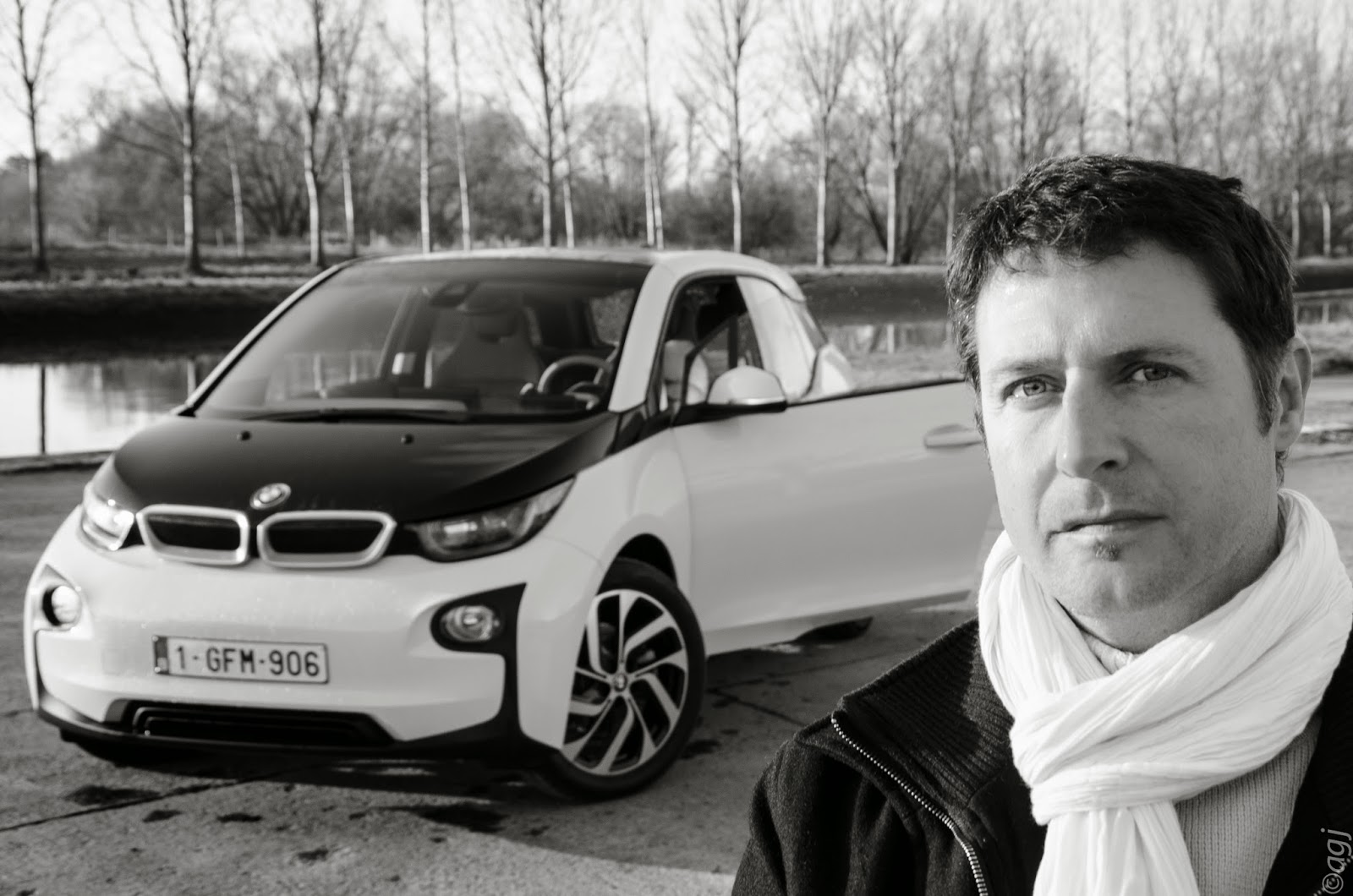
BMW i3 Born Electric Guest Blogger: Meet Toni From Belgium


A while ago I announced that I would be starting a new series here called, "I was Born Electric on...". The series will be featuring readers who are i3 owners and who are willing to share their thoughts on the car after owning it for a while. They will begin the post by introducing themselves and stating the date they were Born Electric, which is when they picked up their i3. Andy from the UK kicked off the Born Electric series and we then visited Hil from Holland. We'll now be traveling to Belgium to visit with Toni and his new Capparis White i3:  


My name is Toni and I was Born Electric on Monday, 27th January, 2014.

The first time I realized that there was an alternative to fossil fuels for propelling a car was in early 2011, when I came across an electronic brochure about the Opel Ampera, the European sibling of the Volt. The more I read about it, the more I was convinced that my next car had to be an electric one.
The reason why I didn't go for the Ampera back then was stupidly financial : 50.000€ for a car was way above what I was willing/able to pay. 
Of course, there were other more affordable electric cars out there. But maybe I was not ready for the leap of faith into electro-mobility yet. Range anxiety was clearly an issue I had to deal with while I waited for my savings account to be able to take the hit of a new car.

Three years later, things had clearly evolved. Both on the EV market and in my personal situation. In the latter, I had enough spare funds to afford a reasonable down payment on a premium car. Moreover, the extensive immersion into electric car literature helped me to come to the conclusion that I did not really need a range extender since more than 95% of my daily commuting could easily be covered by a BEV. The question was then : which car was going to be the one. Ampera/Volt? No, though it definitely is a fantastic car, it still has a tail pipe and I did not want to buy an end-of-cycle model. Tesla? No, too big and too expensive, I did not want to take out a mortgage for the sake of buying a car.  Nissan Leaf? Er, no.  
The BMW i3? Well ... I must admit that my first impression was negative. Not because of its design; actually I am fond of its looks since the very first concepts that appeared in 2011.  But rather because it is a BMW! I never liked BMW. I always considered that BMW was making cars to suit arrogant petrolhead jerks (with all due respect, of course!).

And then I test-drove it. And fell in love.

Was I ready to overcome my prejudices and become a BMW driver myself?  Definitely. Biases are wrong, the car drives like a breeze, the technology inside is outstanding and I too can be a jerk sometimes. : )

So, in order to do penance for my past biases, I decided to devote this blog post to crushing some preconceptions that have been floating around the i3 in some reviews.  And I'll do that from the authoritative position of being the happy owner of a "Shamu Edition" (Capparis white & black - think Shamu the whale)


It is a city car:
No, it is not. Though the car handles incredibly well in an urban environment, it has nothing to be ashamed of when cruising at highway speed. It is fast and responsive. Steering is precise and forgiving at 130 km/h (80 mph).  Overtaking on motorways is a feast. It is a BMW after all, is it not?

The i3 is particularly noisy at high speed:
No, it is not. My first extended drive of the i3 has been the trip back home after delivery at my iAgent dealership. 50 km (30 mi) from Waterloo (Brussels area) to the Mons area where I live. Since the battery was almost fully charged, I decided that I could afford the luxury of squandering away precious kWh's on the E19 motorway. In addition to discovering the driving dynamics described above, I was also curious to put to the test the recurrent criticism I read about unpleasant airflow noises.  I can confirm that in-cabin noises are like taste; there is no accounting for them. I, for one, was not inconvenienced by the airflow at all. I even enjoyed it.


The trunk is too small and the suicide doors are a hindrance:
The question is : Compared to what? 
I am a small car guy. Before the i3, my car was a Mini Cooper. Before that, I owned a Mercedes A-Class (2004 model). Before that, a (discontinued) Rover 220sdi. I know what a small car is. And the i3 is no small car at all by my standards. The trunk offers enough space to generously accommodate the weekly shopping for a family of four. There is plenty of space for my Victorian longbow, arrows included, or for my eldest son's guitar, amp included. 

As for the coach doors, once again it all depends on where you come from. Compared to the coupé-style doors of my Mini, the i3's "antagonist" doors, as they are called in French, are a major step forward in terms of ease of access and comfort. Or to put it in my youngest son's words : "Sooo cooool!".


Materials used for interior trims do not feel "premium":
That was a tricky one.
As I said, price was an important parameter for me, as it surely is for most of us. Given that I accepted the idea of disbursing 40.000+ € for a car, the outlook of spending my driving time in a sleazy environment was distressing me. Of course, I did have the opportunity to feel, touch, smell the interior materials a couple of times before I ordered the car. But assessing the quality of a dashboard or of a leather upholstery is like testing a spring mattress at the mattress store.  No matter how long you try to figure it out, the only way to be sure is to turn the lights off and literally sleep on it.
Though I have not slept in my car (yet), now, I know. The interior is largely up to the price paid. Comfy, stylish, extremely well finished down to the most minute detail. I am almost ashamed of having doubted.  By the way, my i3 has the Lodge interior (Giga world). 

The i3 is just an overpriced Zoe: (I've been reading this one a lot in the French-speaking press).
For the non-European reader, let me first explain that the Renault Zoe (en.wikipedia.org/wiki/Renault_Zoe) is a sort of cute good looking Nissan Leaf, with a French touch.  Don't get me wrong; I think that the Zoe is a nice little car but, c'me on! 

How can a professional journalist put the i3 and the Zoe on the same footing.  How can you compare the past to the future? A car made of steel to the first mass produced car made of aluminum and carbon fibre?
I wish I were an engineer and be able to explain why and how a car with a CFRP body drives so much better than a conventional one. But I am just a linguist and you'll have to bear with my poor description : in the i3, you're just in control!  

The rigidity of the thing makes you feel that there is nothing the car won't take.  You feel light and super secure at the same time.  If you don't believe me, just arrange your own test drive.

Considering the technology, range is unimpressive:
My take on that may sound unconventional.
More range would have been inconsistent with the concept of “great driving experience in a sustainable way”. If my average daily need is 40, why should I store in my car 4, 6 or even 8 times the energy and resources that are necessary?  

In all fairness though, I must confess that I am still struggling with an instinctual range anxiety.
And this is where technology comes to the rescue. The amount of information that comes through the screens is just impressive. The dynamic range assistant, the Eco-route guidance, the graphics, everything has been thought and designed in order to alleviate whatever range fear that I still could have. And it works. On top of that, the resolution quality of the 10.2" screen (professional nav) is remarkable.

I know that there is a bit of controversy as to why BMW did not include a State Of Charge reading in the i3 as in the ActiveE or the Mini E.  Since I never had the chance to drive an EV with a SOC, I guess that my point of view may be considered as neutral on that.

The i3 is an expensive high-tech toy for tree-hugging geeks:
Yes.
It is.
But it is much more than that at the same time.
It's a car.
With all the features, functionalities, looks, behavior, style, technology and feel of a great car.
And yes, it is electric.

So is my i3 living up to all of its promises?
Not quite all of them, for the moment at least.
In Belgium, some of the much anticipated 360° Electric services have not been fully rolled out yet. The Add-On-Mobility (Access or Alternate Mobility program as it is called on other markets) is still largely undefined and the ConnectedDrive services are having a bumpy debut.  Nevertheless, the local BMWi team is working hard on it.

As far as the actual car is concerned though, I can happily report that I haven't found the least flaw yet.
My i3 is the second BMWi to have been registered in Belgium.
And I am very proud to be among the first owners. 

2/5/14 EDIT:
Toni has had a few people ask him about the range since this post went up so he asked me if I could add these words to the post to cover what he has observed so far:

Hi, thank you all for the the nice words!


As for the range, I haven't pushed it to its limits yet. And I doubt I'll ever try to; I'd rather do away with my range anxiety in a non-traumatic way :)

Apart from the maximum range, I think you have to consider the "comfortable" range the car is giving you. By "comfortable" range, I mean the distance you can cover without ever bothering about modes, driving style or even outside temperature and this includes short highway portions. In the case of the i3 (BEV), my experience of the "comfortable" distance is ~62mi (100 km) on one charge.  Remember that, within this range you can drive the way you want. Of course, this "comfortable" range can be jeopardized by a particularly aggressive and non-responsible driving. But, as far as I know, only anti-EV journalists are capable of driving this way.

If your daily commuting includes larger highway portions and/or represents between 62 and 80 mi (100 to 130 km), then I recommend using ECOPRO. Mind you, ECOPRO is not a sub-standard COMFORT mode. The car behaves much like it does in COMFORT mode with only slight differences. Most of them remain unseen by the driver. The only one you do notice is the max speed capping. This speed capping works much like a speed limiter on a conventional car, i.e. you can adjust it in the settings and override it by pressing the right pedal down to "full throttle" when overtaking or in case of emergency. For Europe, ECOPRO default setting is 110km/h (~68 mph).

If you really need to go much farther than 80 mi (130 km) on one charge in a consistent way, you'll probably have to master hypermiling techniques and accept that the ride may become stressing sometimes :)
In this case, I'd recommend going to for the REx version.

If you own an i3 and would like to participate in the Born Electric series here, you can email me at: tom.moloughney@gmail.com

Sunday, January 26, 2014

BMW i3: Tax Credits and Leases and Residuals, Oh My!

Will BMW's financing options put the i3 out of reach for many of its enthusiasts?
There have been many discussions on various websites since an internal BMW document surfaced that led to people to believe the BMW i3 lease terms in the US would be very high. One potential i3 buyer even has his local dealer (Stevens Creek BMW) work up a lease quote using the information on the document. The i3 he built had a total price of $55,978.52. With very little money down the lease payment came out to be $930 per month. There were a couple things that led to this very high lease estimation and I thought it would be worth while to discuss them here.

The proposed i3 lease was posted by insideevs.com
First, the residual values on the document were very low, around 40%. Unfortunately this is basically in line with residual values of other electric cars and there are basically two reasons for it. First, electric cars are new to most people and there is a lot of uncertainty regarding what the secondary market will be. What will a 3 years old i3 with 40,000 miles be worth? How much will the battery have degraded? What will its practical range be at at that point? Until we have years of EV use behind us with tens of thousands of examples to draw data from, finance companies will likely err on the side of caution and offer low residuals on EV's. Then there are the tax credits and rebates. California is the largest market for EV's in the country and basically paves the way for everywhere else. EV's buyers in California not only get the $7,500 federal tax credit, but they also get up to a $2,500 State rebate. Therefore a used EV is instantly worth $10,000 less than a new one as soon as it rolls out of the lot.  So to be fair, you really should include the tax incentives and rebates in the equation when you discuss electric vehicle residual values, because that is the actual effective cost of the car to the buyer.. If you do that, the i3 residuals jump up to nearly 50%. That is still a bit low, but not really far off of what a typical car would be worth after a three year lease. 

The tax credit is now a center of debate
The document also showed that BMW is only going to apply $4,875 of the expected $7,500 federal tax credit as a capitol cost reduction to leases. This led some people to assume BMW is simply pocketing the $2,625. I raised this question to Timm Bock, Product Development & Pricing Manager for BMW Financial Services and he told me that BMW will only realize $4,875 for the federal tax credit and that they will pass every cent of what they get along to the customer. I still don't know exactly why they don't get the full $7,500 because it seems the other EV manufacturers do since they pass it along to the customer as a capitol cost reduction in their lease offerings. So either they get more than BMW does which would be surprising, or they are eating the $2,625 in an effort to push their electric vehicle offerings. This to me would be equally surprising, so I really don't know what the truth is at this point, but I will continue to investigate this. 

Timm was kind enough to also include an overview of the financing options BMW Financial Services will be offering for the i3, and this is what he sent me:
Tom,

Please see my response below regarding the Lease and OwnerChoice products you had asked about, as well as how each product relates to the Federal EV Tax Credit when purchasing a BMW i3.

Traditional Lease - Our tax team has advised us that each leased BMW i3 qualifies us for a Federal EV Tax Credit of $4,875 - all of which is passed on to the consumer.  This $4,875 Lease Credit can be directly applied as a Capitalized Cost Reduction, or to other costs, at the time of lease-signing.  Regardless of your tax situation, by choosing a BMW FS lease with the $4,875 Lease Credit, you'll know exactly how much you will benefit, it’s applied at the time of purchase and there is no subsequent filing, administration or personal tax implications.
(As a reminder, only EVs purchased for personal use are eligible for the maximum $7,500 tax credit.  However, the benefit is reduced to $4,875 for 100% business use.  Regarding Nissan and Chevy, we can’t speak to why they are choosing to offer $7,500 or more; this may be part of the their incentive or discount strategy.)


But for customers who want to claim the maximum tax credits, we have made attractive alternatives to leasing available:  OwnersChoice and OwnersChoice with Flex.

· OwnersChoice – OwnersChoice provides:  low lease-like monthly payments, the lease-like option to return the car at the end of the term AND the eligibility for you to claim the maximum income tax credits.  

· OwnersChoice with Flex - In addition to the OwnersChoice benefits above, OwnersChoice with Flex allows you to increase your final balloon payment due at the end of the contract term by up to $7,500. Increasing the final balloon payment due further reduces your monthly payments, and in this way provides you with the opportunity to benefit from the $7,500 immediately.  OwnersChoice with Flex bridges the time-gap between the vehicle’s purchase date and your tax filing date.  We are proud to say that BMW FS is the first in the industry to develop an enhanced balloon finance solution like this for EVs. 


BMW Financial Services will also offer our traditional loan product.  Like both of the OwnersChoice products above, a BMW FS loan provides you the eligibility to claim the maximum $7,500 Federal EV Income Tax Credit.  


In general, due to the uncertainty and complexity of tax credit rules, we encourage anyone considering an EV to consult with a tax professional.

While this doesn't really clear up the tax credit questions, it does give some clarity on the OwnersChoice with Flex product that they developed specifically for the i3. This will allow a buyer to get the full $7,500 tax credit, yet still return the car like a lease at the end of a predetermined period. It's a purchase, but allows the buyer to have a capitol cost reduction up to $7,500 (the customer decides how much they want BMW FS to deduct as a cap cost reduction) to lower their monthly payments. That money is then owed to BMW FS and the owner can pay it off anytime they want. The owner will then have the option of making a balloon payment equal to the residual value plus the additional $7,500 and buying the car outright, refinancing the balance and keeping the car, or simply paying back the $7,500 and returning the car as if it were leased. 

There is interest charged on the $7,500 cap cost reduction they applied that is baked into your monthly payment, but BMW will allow you to pay it back early and save on the interest expense. The best way to utilize the OwersChoice with Flex may be to pay the $7,500 up front when you take delivery of the car, therefore you'll never have paid a penny of interest on it. Of course you'll need to have the finances to do this, but since you'll be recovering the $7,500 a few months later when you do your taxes, you will only be a short time without the funds. (provided you qualify for the full tax credit)

I hope that provides a little insight into the OwnersChoice with Flex. However, admittedly it doesn't get us any closer to really knowing what leasing deals BMW will be offering. Until we get the official residual values, interest rates and terms, we're all just guessing. I just hope people don't expect the i3 to have leasing deals that are comparable to some other much less expensive EV's like the LEAF or Volt, let alone the great deals on some of the other manufacturers compliance EV's. These cars are subsidized by tens of thousands of dollars per vehicle just so the manufacturer can lease the minimum required be California, in order to continue to sell their gas cars there. BMW has been consistent with saying the i3 is going to be profitable from day 1, and BMW will not subsidize it. This will likely make the i3 more expensive to lease in California than a Honda Fit EV, a Fiat 500e or a Toyota RAV4 EV. However for the rest of the country this comparison really doesn't matter because those cars aren't available nationally like the i3 will be.

Personally I expect to BMW to announce the financing details pretty soon, like within the next couple weeks and I will certainly post them here. There is hope that BMW may surprise up with a good leasing deal after all though. This week at the NADA convention in New Orleans BMW's North American CEO Ludwig Willisch said "It will be an attractive lease offer" and "It will be in the ballpark of a normally equipped 3 Series". A friend of mine recently leased a pretty well equipped 328i and with $3,000 down and he's paying $415/month. I find it hard to believe the i3 will lease for that low, but I suppose it's possible on a base BEV i3 without any options. I'll pick this back up here once the details are revealed. 

Sunday, January 19, 2014

Strong Turnout at JMK BMW For i3 Drive Event

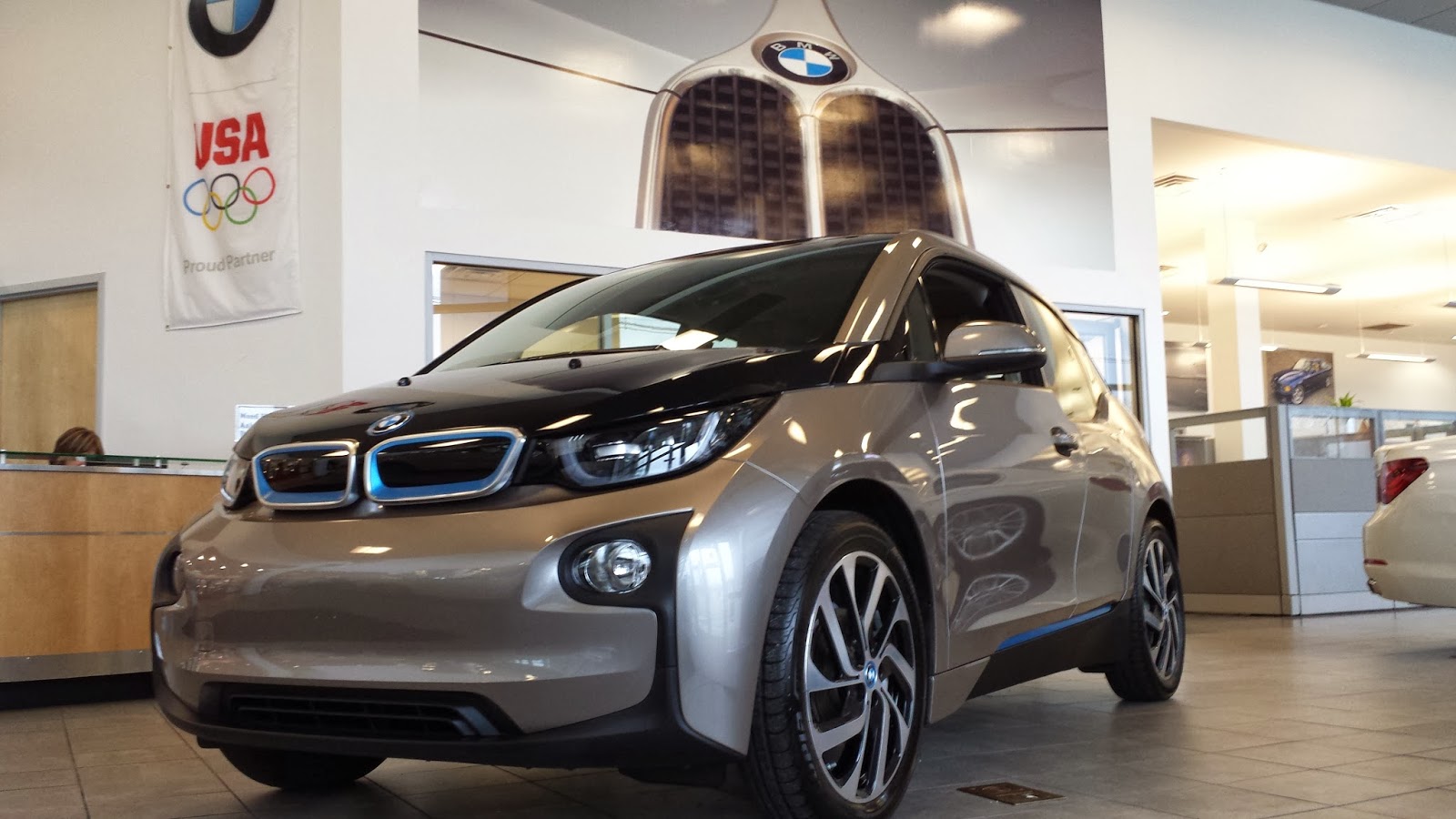
One of the i3's at JMK before they needed to take it off the showroom floor to use for test drives. I'd guess at least 50 test drives were given during the day.
Manny Antunes, JMK BMW client adviser and BMW i3 specialist admitted he was overwhelmed with the amount of people that came to check out and drive the i3's the dealership had for the day last Thursday. BMW gave JMK two i3's for the day and the original plan was to leave one on the showroom floor and use the other one for test drives. However as soon as the day began it became clear they needed both cars for test drives because there were so many people there that signed up to drive an i3. Manny did a great job and was at it all day. He didn't even stop for lunch as there was a line of people waiting all day for test drives.

Manny Antunes & I after a long day
The problem was, once they took the car off the showroom floor there was nothing there for the people waiting for their turn to test drive one to look at. Plus since Manny had to use another client adviser to accompany the customers in the test drives, there really wasn't even anybody from the dealership that could stand there and take on all the i3 questions. However that's exactly why he asked me to stop by, just in case they needed help with answering questions about the i3 or electric cars in general. I usually never mind talking about electric cars, but even I was worn out after over 8 hours of nonstop questions from the 100 or so people that came to see and drive the i3.

Even with running both cars not everybody got to drive one, since both cars drove well over 150 miles they needed to be charged a few times during the day to keep them going. Witnessing the strong demand for test drives was very promising. The range of people I talked to was also surprisingly varied. There were Nissan LEAF owners as well as people that have never even driven in an electric car but had heard about the i3 and were interested in buying one. We also had about six ActiveE drivers stop by to take another look before they decide to place their order for the Electronaut Edition i3 or not.

I'm really happy Manny and JMK reached out to me to give them a hand with the i3 launch. The i3 is going to be like nothing that BMW dealers have ever had to deal with before. Dealers that understand this and reach out for help will be the ones that excel with the i brand and sell a lot of i3's. Nissan and Chevy went through the same thing when they launched their electric car offerings. Some of their dealers are selling plenty of LEAF's and Volt's, yet other dealers in the same markets sell very little. What is the difference? Being prepared. Knowing the product and training the client advisers to know what questions to expect will make all the difference. I know JMK BMW is taking this serious and I'm sure they are going to be one of the areas leading i brand dealerships. Wherever you live, if you are thinking about getting an i3 check out a few of your local BMW dealerships and feel them out a bit. Make sure you find one that is making an effort to really know the i3 and have people on hand that can answer the unique questions that battery electric cars have. If your dealer doesn't know the difference in level 1 and level 2 charging, or they don't know the details of the i3 battery warranty then my recommendation would be to look elsewhere.

It was a crazy hectic day, but it was really great to see how many people came out to test drive this truly revolutionary new BMW.

Friday, November 8, 2013

Strong US i3 Demand Expected, Says CEO Willisch


Predicting demand for electric vehicles has proven to be a difficult task. Both GM and Nissan had admit to not hitting their sales predictions when they first launched their respective electric vehicles. Tesla, on the other hand seems to have their sales constricted by battery supply issues and not by a lack of customer demand.

BMW has been very quiet with regard to talking about sales targets for the i3. It has been reported that BMW will have the ability to make 30,000 i3's per year and could possibly push that up to 40,000 if the demand warrants it. However that isn't right out of the gate. The first year of production will most certainly be much lower than 30,000 regardless of the demand.  Because everything about the i3 requires a completely new manufacturing process it's going to take a little while for BMW to work out any initial kinks in the assembly process. Plus, BMW can only make as many i3's as they get battery cells for. Yes BMW does assemble the battery pack in-house at their Landshut plant, but they do get the cells from a supplier (Samsung) and will be limited to what Samsung can supply.
The i3 battery pack consists of  8 modules, each consisting of 12 individual cells. Pictured above is one i3 module with an individual cell positioned in front.

Initial European orders have been very strong which is good for BMW and a good sign in general for the EV industry, but may squeeze i3 availability for the US market. BMW North American CEO Ludwig Willisch recently told the Automotive News that he believes BMW will sell every i3 allocated to US dealers and wouldn't comment on volume any more than saying  the US would get "more than a few thousand". In 2011, the first full year of US sales for the Volt and the LEAF, they sold 7,345 and 9,655 units respectively. The market for electric vehicles has matured a bit since then which is an advantage for the i3, but the i3 is also much more expensive than either the Volt or the LEAF so that will certainly be a sales-restricting factor in itself. Throw in the fact that we don't know how many i3's BMW can supply the US in the first year and it really is difficult to even guess how many will be sold in 2014. Maybe that's why Willisch and the others at BMW are reluctant to offer any real sales prediction other than to say "strong demand"; or perhaps it's because they watched Nissan and GM fall short and have to address their mistakes and eat a little crow. My guess is it's the latter.

Tuesday, September 3, 2013

What Should The i3 Be Compared To?


Now that BMW has revealed the production version of the i3, including most of its specifications and the MSRP with and without the range extender option, it seems journalists are struggling a bit when they are deciding what other car to compare it to. The result is, they are comparing it to just about everything else with a plug.

A LEAF charging at my restaurant
Since BMW claims it will have about an 80-100 mi range, the inevitable comparisons to the Nissan LEAF have happened. These have largely said the i3 will be faster, offer a better driving experience, has a nicer interior and offers electronic packages and a range extender that Nissan doesn't offer. At the same time, the i3 is $14,000 more than a base LEAF S, has only a marginally better range, has less cargo room and the rear coach doors will be less functional than the LEAF's conventional doors. The LEAF seats 5, while the i3 only seats 4. Exterior styling is pretty much a push, as both cars have unconventional styling that many have said they do not appreciate.

Others have pit the i3 against the Chevy Volt. There is a lot of sense to this comparison because the i3 and the Volt are the only two electric vehicles that have a range extender. The range extender is standard on the Volt; you can't order one without it, while on the i3 it is an option. BMW has stated that they expect the vast
A Volt on display at Nauna's
majority of i3s sold in the US to have the range extender option and I agree with that line of thinking. The i3 has more than two and a half times the electric range of the Volt, allowing most owners to drive on electric a much higher percentage of the time, while the Volt's range extender is more robust and allows the driver to continue driving uninhibitedly once it turns on, even up long mountain climbs. There is still some speculation that the i3 may have difficulty with long, steep mountain climbs once the range extender has come on. The thought is the REx may have difficulty replenishing the energy used in these extreme situations quick enough, but this is still an unknown. Also, the Volt has a 9.3 gallon gas tank so you can drive it up to 380 miles without stopping for gas. The i3 has a 2.4 gallon gas tank so the total range will be less than 200 miles before needing to stop to refuel. The i3 is faster (0-60 in 7.0 seconds compared to the Volts 8.7 sec). Both cars seat 4 with comparable passenger volume but the Volt has more cargo room. The Volt's recent $5,000 price reduction makes it about $10,000 less than an i3 with the REx option, which should be the version of the i3 you use to compare the two. This is a significant advantage for the Volt and the recent surge in Volt sales is proof that people will buy them in large numbers if they believe they are properly priced. A typical BMW customer is accustomed to paying more than a typical Chevrolet customer, but will they see the i3's advantages (performance, much longer AER, cutting edge tech, carbon fiber construction) as worth the premium is yet to be seen.

The i3's interior is nicer than any other IMO
I believe if you must find an EV to compare the i3 to, the Volt is a particularly good one because they are the only two EVs that have range extenders and I definitely believe many customers will select the REx option. I believe that is true partly because many first time EV buyers will want the security of having the range extender there "just in case" and others will opt for it because they find the i3's electric range to be short of what they want in an electric vehicle. I believe if BMW gave the i3 15% to 20% more electric range then the take rate on the range extender would drop precipitously. This is where I think BMW swung and missed. They had the opportunity to put some distance between themselves and every other EV out there other than Tesla's products which are much more expensive. An i3 with an EPA range rating of 110  to 120 miles would have really created a new class of EV, instead they now have a premium version of a Volt combined with a LEAF. With electric cars, a lot of what's premium about the car is range and I'm a bit surprised BMW didn't get that message and offer slightly more range. They didn't need to match Tesla's long range vehicles though. If they just put some distance between themselves and the rest of the pack I think they would have hit a home run. I do believe the i3 will sell well, but it would have been much better received if it offered a slightly longer electric range.

My Model S for a day!
Then there is the Model S. A lot of recent news stories are comparing the i3 to it. Tesla's Model S is the benchmark that all other EVs, rightly or wrongly, will be compared to. That is because it's such a great car. However nothing offered today deserves to be compared to the Model S, it really stands alone at the top of he EV hierarchy. It's not only a great EV, it's great compared to just about anything. I don't like this comparison though, not because the i3 comes up short (literally), but because the least expensive Model S is nearly $30,000 more than an i3. In fact for what the least expensive Model S costs you could buy an i3 and a LEAF S and still have enough money left over to pay for the electricity to drive them both a combined 135,000 miles! Still, I understand why some people want to compare the i3 to the Model S. The i3 is the first EV coming from a "premium" auto manufacturer so they assume BMW was trying to go head to head with Tesla which they obviously weren't. The i3 may very well prove to be as good at what it was designed for as the Model S is at what it was designed for, but only time will tell.

I haven't seen anybody compare it to any of the low volume compliance cars currently being offered and I avoided using any of them here also. As compliance cars the manufacturers only goal is to get them leased or sold as quickly and as painlessly as possible and they can accept huge losses in doing so by heavily discounting them, offering unlimited mileage leases and even giving away free charging equipment. This is all great for the customer, but it doesn't allow a fair comparison.

I've seen a few people say it reminds them of an iMiEV and granted the stubby nose can draw some similarities to the shape, but having driven a few iMiEV's and have sat in a few i3's now I'd advise people to see and drive the i3 before you try to lump them together because they really aren't similar once you've seen the i3 in person. The i3 is more than a foot longer and 7 1/2 inches wider than an iMiEV and has much more interior volume, plus it has 40% more range and the performance isn't really comparable.

So while there is no perfect apples to apples comparison, I think the Chevy Volt is probably what makes sense the most to compare it to and that's only if you are comparing it to the i3 with range extender. However I believe the i3 is different enough that it's going to draw people that may not have bought a LEAF or a Volt, which is good for the plug-in industry. More choices will get more EV's on the road and as they say, a rising tide raises all boats.

Thursday, August 15, 2013

BMW i3 Wins Two Next Green Car Awards


Winners of the 2013  Next Green Car Awards winners were announced yesterday and the BMW i3 claimed the top prize in two of the eight categories. The Next Green Car Awards are said to be the most scientifically-based Green Car Awards in the UK.


Courtesy Gerald Belton
The i3 won  the "2013 Supermini Award" for being "set to change what we expect and demand of an electric urban vehicle; one that maximizes electrification, connectivity, quality and driving performance.” It was won the "2013 City-Car" award. Of that, Suzanne Grey, General Manager BMW i said: "We believe the BMW i3 is a real game changing vehicle because it has been born electric. Being designed from the ground up to be an electric vehicle has resulted in a number of benefits in terms of weight, packaging, range, emissions and driving dynamics."

Other winners included the Nissan LEAF which took home the "Small Family Award", The Tesla Model S (Executive Award), the Volkswagen e-Up! (Next Generation Award) and the Volvo 360 Plug in Hybrid (The Large Family Award).

Dr. Ben Lane, Managing Editor of Next Green Car said: "The 2013 winners reflect two key elements underlying current green car development: drive-train electrification and continuing improvements in fuel efficiency. While all the winners are highly distinctive in the innovations they employ, they all excel at using new technologies to enhance the driver experience."

I have a feeling these won't be the last awards handed out the the i3. It will be interesting to see how the i3 is received when the big automotive news outlets hold their annual "Car of the Year" contests. The Tesla Model S swept many of these awards last year. While I don't expect the i3 to claim as much hardware as the Model S did, I do believe it will score very well up against the other new cars introduced this year.

Sources: Autoevolution.com, insideevs.com

Monday, July 15, 2013

Was Giving the i3 Only 4 Seats an "Unforced Error"?

This i3 spy shot clearly shows a plastic tray separating the two rear seats.
The i3 is going to only have 4 seats. That was something that has pretty much been an accepted fact since BMW first announced the "Megacity" vehicle would go into production. However now that we are on the verge of the official unveiling later this month some people are starting to ask why not make it seat five?

The i3 concept coupe rear seats
I've seen both the original i3 concept and the i3 concept coupe in person and they both appear wide enough to accommodate three people back there. Add the fact that there is no transmission tunnel to get in the way of the middle passengers feet and one does start to wonder about it. Over in the Facebook i3 group, Anton Wahlman, a contributor to The Street likened BMW's decision to make the i3 only seat four an "unforced error" since it would appear the car could accommodate three in the rear seat if only BMW had wanted it to. Anton said:
"
If you can't fit 3 people in the rear seat, it will significantly reduce the propensity of a Volt owner to switch. If this is true, it would be an unforced error in terms of understanding the (American) consumer." He also said:
"
The #1 reason I hear people aren't buying the Volt is the lack of seating for 5. Not the ONLY reason, but the single most frequent one. GM knows this, so the Volt 2.0 (2015 model, launched in 2014) will fit 3 people in the back seat."
Anton is speaking from experience, he drives a Volt. He makes a very good point about a Volt owner switching to an i3. 

Both the Chevy Volt and the Nissan LEAF launched in December of 2010. So anyone that was an early adopter and rushed out to get one of the first Volts or LEAFs took delivery in the end of 2010 to the beginning of 2011. Many of these people took the attractive 3 year lease options offered and guess when all those leases are expiring? Yep, pretty much exactly when the i3 will be launching. The i3 is the perfect next step for existing Volt and LEAF owners because it offers more electric range plus a range extender, a combination no other EV does. I have personally received dozens of messages and emails from people in this position wanting to know if I had inside information about the exact launch date because they want to transition directly from their LEAF or Volt into an i3 but don't know if the i3 will be available when their lease expires. 
The original concept had rear bucket seats

As Anton mentioned, it's rumored that Chevy is going to make a 5 seat Volt for the 2015 model. If so, they will sell both a 4 seat Volt and a 5 Seat Volt when the redesigned Volt 2.0 is released later next year. So apparently the Volts lack of a 5th seat was a significant issue, enough for GM to redesign the battery tunnel to allow for a center rear seat. Since the i3 doesn't have a battery tunnel in the first place, and appears to be about as wide as a Volt there must be other reasons BMW elected to make the back seat only for two passengers. Weight considerations could be the main culprit I suspect but regulatory issues and crash test ratings could be possible reasons also. We know how hard BMW worked to keep the i3 weight as low as possible, shedding every pound that wasn't absolutely essential. A lot more goes into adding the third seat than simply adding an extra seatbelt. The suspension would also need to be modified which would add weight and make for a stiffer ride. I wonder if BMW will do what they did with the MINI Countryman and offer a third seat option at a later date if this becomes a bigger issue than they expect. 

Taking all that into consideration, BMW still hasn't revealed the exact width of the production i3. They did reveal the length in the recent press release which surprisingly will be 6 inches longer than the original i3 concept was. The original concept was 151.4" and the production i3 will be 157.4". It will be interesting to see what the width actually is. If it's wider than 67" (which is about what a 5 passenger Honda Fit is at 66.7") then I may agree with Anton about it being an unforced error unless BMW gives a proper explanation why adding the fifth seat would not have been a good idea. I'm sure offering the i3 as a 5 passenger vehicle compared to a 4 passenger vehicle would open it up to a much broader audience of perspective buyers. After all, virtually all of the top selling passenger cars in the US are 5 passenger vehicles for a reason. 
This is probably the best interior picture of an i3 available. You can see it appears there is plenty of rear legroom