Showing posts with label state of charge. Show all posts

Tuesday, April 22, 2014

More Range Extender Details Uncovered At BMW i Dealer Training


BMW has been hosting i3 training events to get their client advisers up to speed and ready to sell the car. I'm very happy to hear they are doing this because I was really beginning to get concerned that they wouldn't properly prepare their sales staff for this unique vehicle. I even dedicated a post a few months ago to this very topic. I've now talked to a few client advisers that have done the training and they reported that they did indeed get a lot of useful information which will help them service their clients.
The i3's tiny fuel tank is seen here at right in front of the battery pack in the center of the car.  This is where the heat pump is located and why you cannot get the heat pump if you have an i3 REx

This week the latest round of training sessions are being held up at BMW headquarters in Woodcliff Lake, NJ and details of what is being taught are starting to leak out from some of the client advisers that are there. A couple things of interest shared were details about the range extender the i3 will offer as an option.

First, it was learned that the range extender is automatically activated once the state of charge drops below 6.5%. At that moment, it turns on and it's function is to bring the state of charge back up to 6.5% and to maintain that level of charge. It will not charge the car much above 6.5%, and it will not run if the car is stopped, unless the state of charge is critically low. Therefore you can't it in a stationary i3 and wait for the state of charge to increase. I knew the automatic turn on point was around 5% to 6%, but now we have an exact level when it engages.
US i3 REx customers wish they had the European "hold" feature available

You cannot manually turn the range extender off. This is contrary to what I was told by an i3 product manager at the i3 debut in New York City last July. I remember asking this specific question by saying "What if I knew I'd make it home on electric, say I only had a mile or two to go and the REx was about to turn on, could I just turn it off so it's doesn't fire up?" I was told yes, there will be a setting that will allow you to turn it off before it engages, but that setting will reset once you turn the car off. The reason for that is so that the next time you get in the car you won't forget that you had turned off the REx and you may end up needing it. I would have definitely preferred to be able to turn it off manually, and honestly can't see why that isn't going to be allowed.

The range extender exhaust is tucked away under the car so you can't see the tailpipe unless you crawl underneath to look
We also found out that the client advisers have been told that while the range extender is in operation the speed of the car will be electronically limited to 70mph. I'm not buying that; I think they were misinformed. I really think there was a miscommunication on this one because I have had conversations with people at BMW that know a lot about this and even very recently they assured me that there isn't an electronically governed speed limit while the range extender is in operation. I believe the confusion about 70mph is based on the fact that 70mph is basically the top speed that the range extender can comfortably maintain the 6.5% state of charge at while driving on relatively flat ground. The people I've talked to in Europe that have i3's with the range extender say they can drive on the highway at just about 120 km/hr (75mph) and maintain the SOC, but anything higher and the SOC will gradually diminish. It's my contention that the people running the training sessions either aren't 100% clear on this, or they really meant for the client advisers to warn the customers that 70mph is really the fastest they should drive at if they need to drive for a long distance. In any event, I believe they got this one wrong and there isn't an electronic limit, we'll find out pretty soon since the US i3 launch should be in about two weeks.
The BMW i3 range extender is located next to the electric motor and power electronics, over the rear axle.
I saved the biggest news for last. It was learned that the US version of the i3 REx will have not have a 2.4 gallon gas tank as the European version does. Instead it will have only a 1.9 gallon gas tank. I'm going to pause for a moment to let everybody scream bloody murder now...... I know it's only half a gallon, but in the case of the i3, that just reduced the gas tank by 21%! For me this is a non-issue, but I know there are a lot of people that will not like this at all. 99% of the time I use the added range of the REx it will likely be for less than 40 miles. Yes, this does reduce the utility of long range trips even more, as you will now probably have to stop for gas every 40 or 50 miles. There was no reasons given for the smaller gas tank but as far as I can imagine, this comes down to one of two things. Since BMW wants needs the i3 REx to qualify as a BEVx and one of the qualifications of the BEVx is that the car has a smaller gasoline range than it does electric range, my thinking is that one of these two things led to the smaller gas tank:

1) The EPA rating for all electric range on the REx came out lower than they believed it would. If they used the 2.4 gallon gas tank, the gas range would be slightly longer than the all electric range, therefore causing it to be disqualified for the BEVx designation. The only simple way to make the gas range less than the electric range was to reduce the gas range by using a smaller gas tank.

2) The EPA rating for the MPG while in range extender mode came out higher than expected, creating the same problem cited above; a longer range in REx mode than in all electric mode. I've heard it gets anywhere from 36mpg to 46mpg from people driving REx's in Europe so this is a possibility. If the range extender got rated at 40mpg, and was using a 2.4 gallon gas tank, then the electric range would need to be 96 miles per charge, which is highly unlikely. If they cut the tank down to 1.9 gallons, then the electric range would only need to be greater than 79 miles per charge, which I believe is attainable, even considering that the REx version will have 6.5% less battery to use than the BEV i3 does, as this is held in reserve as a buffer.

So what do you think? Has any of these new revelations changed you mind about the REx?


Thursday, April 3, 2014

BMW i3 REx European Road Trip!


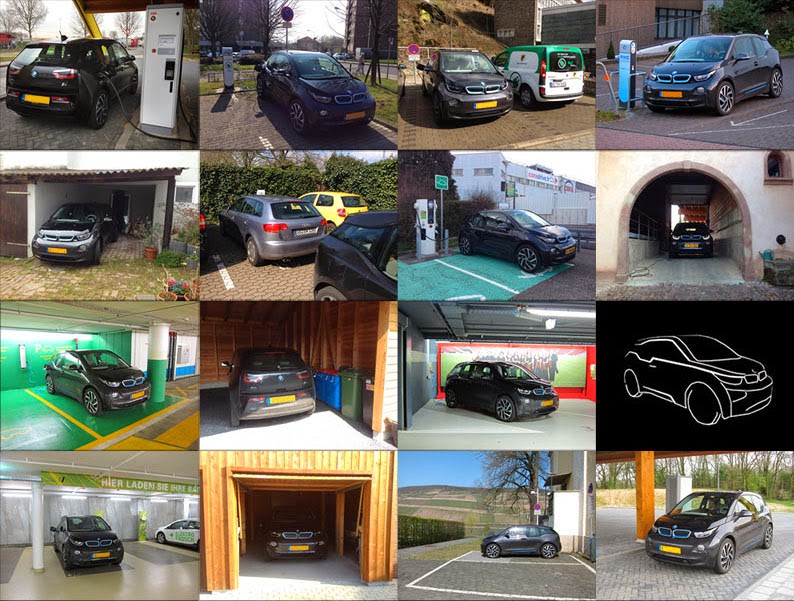
Back in February we featured Steven from The Netherlands as a Born Electric guest blogger. At the time he mentioned to me that he was planning a road trip with his i3 REx that would take him on a fantastic journey from The Netherlands through Germany and France to the final destination of Switzerland. The funny thing is, I almost was able to meet him along the trip because I was actually in Switzerland the week before he arrived and my wife and I even spent an afternoon at the same lake in Zurich you see pictured below! In any event, once I heard Steven was about to engage upon this 1,100 mile road trip I asked him if he wouldn't mind sharing the details here once he returns and he was kind enough to do so. I get a lot of questions about the range extender, and many people want to know if it is possible to take it on a long trip. This post doesn't answer every question, but it does give some insight into how the car will perform on sure an extended road trip. I haven't read any story of an i3 doing a road trip over 1,100 miles yet, so this may be the first account of such a journey.


Travelcompanion: i3

OK, so we have this i3. It was, and still is, marketed as a city slicker. The question arises: is BMW underestimating itself ?

To begin with the conclusion: yes and no. It will go outside the city and beyond, with quite an aplomb at that, but its driver needs some commitment and perseverance to get there. As stated by Tom elsewhere: it is not a go anywhere, do anything car. With a normal to brisk driving style, it excels on local trips with perhaps a charge or two along the way. But when taking it easy, tourist style, it can haul you much further than your cities limits.


Once you get used to its unconventional lines the design grows on you.
Our i3 in the Appenzeller mountains.
The commitment starts with a careful planning. Call me a nerd, but I rather like planning a trip in detail, time allowing. However, the limited electric range did cause a little frustration. Frustration about not being able to reach the higher alpine passes in the six days we reserved for this trip. When pushed, we certainly could have done it, but in the end we opted to make the journey itself the goal.

The first hurdle is Europe not being the United States of Europe. Different plugs, different chargecards, you name it. Totally unfunny. Luckily, one of Hollands energy suppliers is owned by RWE, a large German energy supplier, so we could apply for a German charge-ID. You’ll need an app on your iPhone to start the charger, but that’s ok. For France and Switzerland, we’re out of luck. A lot of local/regional initiatives, so charging possibilities are limited to free chargers or, in Switzerland, chargers mounted in parking garages where charging is complementary or at a cost, payable at the checkout machines. And these have to match our Mennekes plug as well.

As you’ll understand, planning took a while, especially while I was not only looking for locations to charge, but also for roads worth driving and places worth visiting while charging. Not much fun to be stuck on an industrial estate for three hours… In the end, I planned our trip so that it would take us three days to reach Switzerland, leaving much of the motorway behind after crossing the Dutch border. Slow tourism, like our parents did with their 2cv, before Europe was shrunk by the proliferation of the Autobahn.

Departure

Smoothly gliding away, to not disturb our neighbours, is uneventful in itself. EcoPro is on, but so is the heat, for it was freezing during the night. Damn, we’ll need those electrons! Well, not entirely, to be truthful, for our first stop is at a 50 KW fast charger. The residual charge doesn’t seem to matter much at the fast chargers’; it’ll charge to 90% in 30 minutes anyway. But there seems to be a catch. We left the charger with ~94%, but the charge dropped right down to 86% in a matter of minutes. Something we have observed more than once after a fast charge. A pity in this case, because the next station should have been reachable with a margin. A margin worth having, for we were able to reach our designated charger with only 5 km (3 mi) on the clock. But hey, it was supposed to be an adventure !

This is the point where I have to admit we are driving the i3 ‘chicken version’, with the little REx in the boot. The upside: unlimited mobility. The downside: REx wakes at 5-6 km, no matter what. So we were at the threshold of failure to do the E-thing, and that only two hours into our journey! But we made it. We had lunch, walked the totally unremarkable town, takin’ it easy as promised, until the car was charged enough to reach our next goal. The ability to use your smartphone to monitor the car is invaluable.

The next goal: Monschau. A quaint little town, picture book stuff. Flocking with tourists of a more advanced age when in season, it is actually very nice when not. Coffee, apfelstrudel, you’ll get my drift how we passed the time.

Chargetourism: Monschau
With enough inside us and in the i3, off to the next charger. A short charging session of 32 minutes at 32 amps in Daun was all it took to take us to our hotel in Bernkastel-Kues. Again a picturesque village, this time with a larger river (the Mosel) and an ancient castle on the adjoining mountain. And the best news: we have entered the wine region, so the i3 was not the only one being replenished :)

At this hotel, we had the first experience of the friendly cooperation we would encounter along the way. We were fully prepared to have to drive the car to a charging station nearby and to walk back, but the hotel owner promptly offered us a spot in his yard where we were able to plug in under the carport. Sweet.


France

Day two took us through Germany to France. Our second hurdle: the designated electrospots in Saarbrücken were occupied by gas-burners! A Zoe was already double parked and charging, but i3’s cable is not long enough to do this. Damn. Now what? Time for friendly cooperation example #2: the receptionist of the adjoining offices came out to ask us if everything was ok, noticing of course it wasn’t because of me standing there with a large blue cable in my hands, looking lost. The solution was easy: one of the owners of the damned vehicles didn’t mind to take a hike, so we could charge, albeit with a little delay. The upside: the German owner of the double parked Zoe turned up, so we had an opportunity for a nice conversation about the future of the world.

Charged and fed, off to France we went. One possibility to charge with no alternatives. Gold or bust! Golden it was. Free of charge as well. Very good of the Cora supermarket to lure crazy dutch electrotourists to their store :) With enough cheese and charge, we took off through the Alsace, an area we always quite enjoy for a lot of reasons.

One of the reasons is that it has some nice drivers’ roads with not to much other people on them. We already enjoyed some nice, but not too quick, driving in the German Eifel yesterday, and the Alsace didn’t disappoint. Nor did the i3, so it is time for some car stuff, for this is supposed to be a car blog last time I checked….

Like!
I like to start with some downsides here, so I can end the paragraph on a positive note. And I will lift a tip of the vail: it is a very positive note. But first: the grind. Although visibility all around isn’t exactly bad, the car is difficult to oversee, so it takes more practice than I’m accustomed to, to position the car in exactly the spot on the  road you want it to be when driving spiritedly. It is growing on me, of course, but it is still not an intuitive process. I guess it has to do something with not seeing any of the nose or any other external part and the overview you miss in tight left hand bends because of the drivers side A pillar. I am still not used to have to look through the side windows to oversee that tight left-hander. Then there is the steering. Once accustomed, it is excellent and precise, but so direct that you’ll have to handle it smoothly if you want to impress your co-driver with your cornering style. And the last grump, which is really a very small niggle: close the rear doors firmly before doin’ the bends, for the warning signal for these is on a hair-trigger. (Tom's note: I have had other i3 owners tell me this also. If you don't close the rear door firmly, the "door ajar" light can light up while you are driving. It's in no danger of opening, it's just an oversensitive trigger than needs to be fully depressed).

Now for the gold: Do we enjoy it when it is going where no i3 has gone before? Oh yes! Yes! It is fast and nimble, which is good in itself, but it is the smooth as cream comfort that is the hammer. The suspension is firm, you already know that, so that is not the unique selling point comfort-wise. It is the easy, creamy-smooth instant power, the effortless recuperation, the relaxed one pedal driving that makes it so enjoyable to drive on your winding Alsacien roads! Take it out, that i3, if you have it, I’ll think you’ll enjoy it as much as I do !

With plenty charge left, we arrived in the quaint Alsacien winemakers’ town to fill up us and the i3 again at the B&B, a winemakers establishment. My advice: go there, drive the roads, drink the wine. Just do it in that order!

Switzerland

Not much to tell about day three, this being a car blog. Only that the leg to Basel was 106 km, mainly motorway, so we kept it between 90-100 (55-60) in the right lane to reach our destination with some electrons to spare, for alternative usable charging stations are sparse around there. With plenty of charge to get us to our next B&B we left sunny Basel and the river Rhine. 40% charge was a luxury I could enjoy for the 10 km (6 mi) drive to and fro from the B&B to the evenings’ restaurant later. This little drive was, besides enjoyable, also a good reminder for me to keep driving carefully during the day to make the most of our E-range, for the battery had only 16% remaining when plugging back in at our B&B at night. Do the math if you like. In our defence, we had the heat on on the way back…
Goal #1: Make it to Zurich using only electric power
Being already very pleased we reached our goal of getting to Zürich fully electric the next day, we set a new goal of reaching at least 1000 km (621 mi) of uninterrupted E-use. After a very enjoyable day in Zürich and at our friends there, totally uninteresting for you i3 enthousiasts, we started drifting in the ‘back’ direction on Saturday afternoon. With one final Swiss charge in St Gallen remaining, we took the i3 through Appenzell. Some mountain roads, not the most spectacular passes, but still sporting brisk climbs once more affirmed our belief that the i3 is a very nice car indeed. It's hard to keep your foot off that throttle :-)).
Goal #2: 1,000 km all electric
Then we reached the dreaded point that was looming in the planning all along. It was not the Swiss border which we passed without ado, it was the point at which the beast in the back had to be awoken. Time for a little car talk intermezzo.

REx

I can understand that a lot of people question the execution of BMW’s REx solution. On the risk of repeating myself: I think they did a wonderful job, for it feels nearly sinful to start the REx after driving on electrons. So smooth. So quiet. So soothing for the conscience. You really get the feeling of doing the wrong thing when firing up ye olde’ ICE. And this is how it should be. It is an electric vehicle extended, mind you! Besides from this, the little bugger does its best to keep you mobile. We here in Europe have it easy, sorry about that American brethren, for we can engage REx at will, so we don’t have to motor through towns and countryside, but we can plan our  REx extension to happen anywhere along the way. The added bonus is of course that you can keep a nice safety cushion in the battery to get it up that Autobahn-slope, although it has to be said I was quite taken with the ability if the REx to keep up the battery when doing 120 (75) on the cruise with A/C to boot. On those not to steep but long slopes (climbing ~250 meters in ~35 km (~820 ft/~22 mi)), the battery level drops a little bit, of course, but I would say that a cushion of around 5% could just about, or just about not, suffice for most journeys. One thing I have noticed is that is seems that the car allows for a bigger battery-drift if you engage the REx earlier. One advantage of this is that it doesn’t have to run at top revs all the time to keep the state of charge on the small marker on your dash-display. Once the state of charge is low, it works very hard to maintain the 5% and prevent very low charge. To end this intermezzo about the REx something on fuel consumption. Exactly economical it is not. Doing 120 (75mph) on cruise gives you something of 15-16 km per litre (35-38 mpg us). Not too bad, not great. Taking 10 km (6 mi/hr) off the speed does wonders to this consumption however, but we kept it at 120 (75) where allowed.
Driving on the Autobahn: Speed kills - consumption rate that is!
A relatively uneventful 628 km (390 mi) later: home. We made a little touristic detour along the Rhine, which we used to recharge a bit during lunch, so we could cruise the 50 km (31 mi) of Rhine-borders in tranquility, and we recharged again at our nearby fast charger to make the last stretch on electricity before parking the car at its homespot with a feeling of well done planner, well done driver, well done little car. It is not perfect, but it is loveable all the way. And it’ll go further if you dare it…
Final stats of the journey
Map of journey


1780 km (1,104 mi), plugging in 16 times during the trip
Approximation of route travelled (source: Google)


Disclaimer - We have undertaken this trip and I have written this article on a strictly personal basis. I am not affiliated to BMW or anyones business mentioned in this story. Please mind that everything you’ve read here are my/our personal experiences and opinions and should be treated as such. Also, bear in mind that the English language is not my native one, so be patient if I’ve made some mistakes or used clumsy language. Any offence is unintentional.

Regards, Steven


A postcard from Steven to summarize his charging efforts along the way!

Monday, February 3, 2014

BMW i3 Born Electric Guest Blogger: Meet Toni From Belgium


A while ago I announced that I would be starting a new series here called, "I was Born Electric on...". The series will be featuring readers who are i3 owners and who are willing to share their thoughts on the car after owning it for a while. They will begin the post by introducing themselves and stating the date they were Born Electric, which is when they picked up their i3. Andy from the UK kicked off the Born Electric series and we then visited Hil from Holland. We'll now be traveling to Belgium to visit with Toni and his new Capparis White i3:  


My name is Toni and I was Born Electric on Monday, 27th January, 2014.

The first time I realized that there was an alternative to fossil fuels for propelling a car was in early 2011, when I came across an electronic brochure about the Opel Ampera, the European sibling of the Volt. The more I read about it, the more I was convinced that my next car had to be an electric one.
The reason why I didn't go for the Ampera back then was stupidly financial : 50.000€ for a car was way above what I was willing/able to pay. 
Of course, there were other more affordable electric cars out there. But maybe I was not ready for the leap of faith into electro-mobility yet. Range anxiety was clearly an issue I had to deal with while I waited for my savings account to be able to take the hit of a new car.

Three years later, things had clearly evolved. Both on the EV market and in my personal situation. In the latter, I had enough spare funds to afford a reasonable down payment on a premium car. Moreover, the extensive immersion into electric car literature helped me to come to the conclusion that I did not really need a range extender since more than 95% of my daily commuting could easily be covered by a BEV. The question was then : which car was going to be the one. Ampera/Volt? No, though it definitely is a fantastic car, it still has a tail pipe and I did not want to buy an end-of-cycle model. Tesla? No, too big and too expensive, I did not want to take out a mortgage for the sake of buying a car.  Nissan Leaf? Er, no.  
The BMW i3? Well ... I must admit that my first impression was negative. Not because of its design; actually I am fond of its looks since the very first concepts that appeared in 2011.  But rather because it is a BMW! I never liked BMW. I always considered that BMW was making cars to suit arrogant petrolhead jerks (with all due respect, of course!).

And then I test-drove it. And fell in love.

Was I ready to overcome my prejudices and become a BMW driver myself?  Definitely. Biases are wrong, the car drives like a breeze, the technology inside is outstanding and I too can be a jerk sometimes. : )

So, in order to do penance for my past biases, I decided to devote this blog post to crushing some preconceptions that have been floating around the i3 in some reviews.  And I'll do that from the authoritative position of being the happy owner of a "Shamu Edition" (Capparis white & black - think Shamu the whale)


It is a city car:
No, it is not. Though the car handles incredibly well in an urban environment, it has nothing to be ashamed of when cruising at highway speed. It is fast and responsive. Steering is precise and forgiving at 130 km/h (80 mph).  Overtaking on motorways is a feast. It is a BMW after all, is it not?

The i3 is particularly noisy at high speed:
No, it is not. My first extended drive of the i3 has been the trip back home after delivery at my iAgent dealership. 50 km (30 mi) from Waterloo (Brussels area) to the Mons area where I live. Since the battery was almost fully charged, I decided that I could afford the luxury of squandering away precious kWh's on the E19 motorway. In addition to discovering the driving dynamics described above, I was also curious to put to the test the recurrent criticism I read about unpleasant airflow noises.  I can confirm that in-cabin noises are like taste; there is no accounting for them. I, for one, was not inconvenienced by the airflow at all. I even enjoyed it.


The trunk is too small and the suicide doors are a hindrance:
The question is : Compared to what? 
I am a small car guy. Before the i3, my car was a Mini Cooper. Before that, I owned a Mercedes A-Class (2004 model). Before that, a (discontinued) Rover 220sdi. I know what a small car is. And the i3 is no small car at all by my standards. The trunk offers enough space to generously accommodate the weekly shopping for a family of four. There is plenty of space for my Victorian longbow, arrows included, or for my eldest son's guitar, amp included. 

As for the coach doors, once again it all depends on where you come from. Compared to the coupé-style doors of my Mini, the i3's "antagonist" doors, as they are called in French, are a major step forward in terms of ease of access and comfort. Or to put it in my youngest son's words : "Sooo cooool!".


Materials used for interior trims do not feel "premium":
That was a tricky one.
As I said, price was an important parameter for me, as it surely is for most of us. Given that I accepted the idea of disbursing 40.000+ € for a car, the outlook of spending my driving time in a sleazy environment was distressing me. Of course, I did have the opportunity to feel, touch, smell the interior materials a couple of times before I ordered the car. But assessing the quality of a dashboard or of a leather upholstery is like testing a spring mattress at the mattress store.  No matter how long you try to figure it out, the only way to be sure is to turn the lights off and literally sleep on it.
Though I have not slept in my car (yet), now, I know. The interior is largely up to the price paid. Comfy, stylish, extremely well finished down to the most minute detail. I am almost ashamed of having doubted.  By the way, my i3 has the Lodge interior (Giga world). 

The i3 is just an overpriced Zoe: (I've been reading this one a lot in the French-speaking press).
For the non-European reader, let me first explain that the Renault Zoe (en.wikipedia.org/wiki/Renault_Zoe) is a sort of cute good looking Nissan Leaf, with a French touch.  Don't get me wrong; I think that the Zoe is a nice little car but, c'me on! 

How can a professional journalist put the i3 and the Zoe on the same footing.  How can you compare the past to the future? A car made of steel to the first mass produced car made of aluminum and carbon fibre?
I wish I were an engineer and be able to explain why and how a car with a CFRP body drives so much better than a conventional one. But I am just a linguist and you'll have to bear with my poor description : in the i3, you're just in control!  

The rigidity of the thing makes you feel that there is nothing the car won't take.  You feel light and super secure at the same time.  If you don't believe me, just arrange your own test drive.

Considering the technology, range is unimpressive:
My take on that may sound unconventional.
More range would have been inconsistent with the concept of “great driving experience in a sustainable way”. If my average daily need is 40, why should I store in my car 4, 6 or even 8 times the energy and resources that are necessary?  

In all fairness though, I must confess that I am still struggling with an instinctual range anxiety.
And this is where technology comes to the rescue. The amount of information that comes through the screens is just impressive. The dynamic range assistant, the Eco-route guidance, the graphics, everything has been thought and designed in order to alleviate whatever range fear that I still could have. And it works. On top of that, the resolution quality of the 10.2" screen (professional nav) is remarkable.

I know that there is a bit of controversy as to why BMW did not include a State Of Charge reading in the i3 as in the ActiveE or the Mini E.  Since I never had the chance to drive an EV with a SOC, I guess that my point of view may be considered as neutral on that.

The i3 is an expensive high-tech toy for tree-hugging geeks:
Yes.
It is.
But it is much more than that at the same time.
It's a car.
With all the features, functionalities, looks, behavior, style, technology and feel of a great car.
And yes, it is electric.

So is my i3 living up to all of its promises?
Not quite all of them, for the moment at least.
In Belgium, some of the much anticipated 360° Electric services have not been fully rolled out yet. The Add-On-Mobility (Access or Alternate Mobility program as it is called on other markets) is still largely undefined and the ConnectedDrive services are having a bumpy debut.  Nevertheless, the local BMWi team is working hard on it.

As far as the actual car is concerned though, I can happily report that I haven't found the least flaw yet.
My i3 is the second BMWi to have been registered in Belgium.
And I am very proud to be among the first owners. 

2/5/14 EDIT:
Toni has had a few people ask him about the range since this post went up so he asked me if I could add these words to the post to cover what he has observed so far:

Hi, thank you all for the the nice words!


As for the range, I haven't pushed it to its limits yet. And I doubt I'll ever try to; I'd rather do away with my range anxiety in a non-traumatic way :)

Apart from the maximum range, I think you have to consider the "comfortable" range the car is giving you. By "comfortable" range, I mean the distance you can cover without ever bothering about modes, driving style or even outside temperature and this includes short highway portions. In the case of the i3 (BEV), my experience of the "comfortable" distance is ~62mi (100 km) on one charge.  Remember that, within this range you can drive the way you want. Of course, this "comfortable" range can be jeopardized by a particularly aggressive and non-responsible driving. But, as far as I know, only anti-EV journalists are capable of driving this way.

If your daily commuting includes larger highway portions and/or represents between 62 and 80 mi (100 to 130 km), then I recommend using ECOPRO. Mind you, ECOPRO is not a sub-standard COMFORT mode. The car behaves much like it does in COMFORT mode with only slight differences. Most of them remain unseen by the driver. The only one you do notice is the max speed capping. This speed capping works much like a speed limiter on a conventional car, i.e. you can adjust it in the settings and override it by pressing the right pedal down to "full throttle" when overtaking or in case of emergency. For Europe, ECOPRO default setting is 110km/h (~68 mph).

If you really need to go much farther than 80 mi (130 km) on one charge in a consistent way, you'll probably have to master hypermiling techniques and accept that the ride may become stressing sometimes :)
In this case, I'd recommend going to for the REx version.

If you own an i3 and would like to participate in the Born Electric series here, you can email me at: tom.moloughney@gmail.com

Wednesday, December 4, 2013

No Numeric State of Charge Display on the i3? Really?

One of the advantages of not being first to market in any industry is the fact that you get the opportunity to study the competition's product and see what worked and what didn't so you don't make the same mistakes. One example in the EV industry would be to look at how Nissan is having difficulty with early battery degradation in the LEAF, especially in hot weather climates. It seems clear a sophisticated active thermal management system greatly reduces these issues by keeping the cells from overheating and from remaining at very high temperatures for prolonged periods of time. Besides watching the competition, BMW also gained a lot of useful data and feedback from the MINI-E and ActiveE programs. This, in my opinion, should have greatly reduced the chance that BMW would make a major mistake with the i3.

The MINI-E SOC was front and center
After driving the i3 four separate times now, I am pretty convinced it provides the driving experience I was hoping for. It's very quick and instantly responsive, has very precise steering and extremely short braking distances. The regenerative braking is nice and strong, although it's slightly weaker than it was on the ActiveE. It definitely is the "hot hatch" I was hoping it would be. That being said, it's not perfect - and I didn't expect it would be, but I didn't expect BMW to make an obvious critical error that could have easily been avoided, which I believe they did by omitting the state of charge display.
 
The ActiveE SOC & Battery Temp
Both the MINI-E and ActiveE  had a numeric SOC display and honestly that is all I ever use when I'm driving. I don't care what the estimated range indicator says. No matter how precise it is, it doesn't know how fast I'll be driving, if I am carrying three passengers with cargo or driving alone, if I'm going to be driving up a mountain or on flat ground. All these factors will influence how far the car will take you on any particular trip. The state of charge indicator is crucial for me and I believe I'll feel lost for a while driving an electric car without it. Sure, I'll get used to the bar graph on the drivers display screen, and I can kind of figure out the approximate state of charge, but that's unacceptable as far as I'm concerned. Let me see my state of charge and I know how far I can go. I'm not saying BMW should eliminate the other information they want to show, like the bar graph and estimated range. Go ahead and display that on the main drivers screen if you like, but give me the SOC somewhere so I can look at it if I want to. The car has the information available, why not include it on a screen somewhere, I don't mind if I have to look in the iDrive to find it.
What's the state of charge? 54%? 56%? I guess it's somewhere around there but I want to know precisely. Every percentage point counts some days in an EV when you are stretching the range. I want to see the SOC displayed in a simple numeric value somewhere.

BMW had a special event private at the LA Auto Show for ActiveE drivers only. I believe most people felt as enthusiastic about the i3 driving experience as I did, yet a lot of the conversations were about the lack of a state of charge gauge and how baffled many of us were about this. When the time came for a Q&A session it didn't take long for it to be asked and BMW tried their best to explain that the i3's range predictor will be so accurate that a proper SOC gauge isn't needed. That didn't sit well with the ActiveE drivers and the protest continued until the managers said they hear our displeasure and promise to revisit this, opening the possibility to adding the state of charge display before the US launch - or possibly just to quiet us down a bit and move on the the next topic!
There it is! 85.5% state of charge - only US customers don't get to see it!

One thing I found interesting is that on the European i3's, at least the one's with the range extender option, there is a state of charge display. A BMW i3 forum member sent me the above picture as proof. However here in the US that screen isn't available since unlike in Europe, US customers will not have the ability to manually turn on the range extender once the state of charge dips below 75%. The inability to do so does make the range extender less useful, however how much less useful is a story for another day once I've had the opportunity to properly test drive an i3 REx with a depleted battery in range extender mode. The point is, the car knows its state of charge and can display it for European REx customers, so why not just make the display standard on all i3's and make everybody happy?

Will this prevent me from buying an i3? No. Will it make the driving experience much worse? Probably not. What bothers me more than anything else is this is something the MINI-E and ActiveE were overwhelmingly in favor of and I don't know how BMW missed it. The point of the MINI-E and ActiveE trials were to find out things like this so the i3 and future BMW electrics would be the best they could be. I hate to really harp on this so much but I'm really disappointed this was somehow overlooked. It's not a little oversight, it's a major omission to me because it's something their pool of beta testers appreciated and wanted on their future EV's. When the Nissan Leaf launched back in 2010 it didn't have a state of charge gauge and the LEAF owners were very disappointed. So much so that they complained continuously until Nissan added the state of charge gauge two years later. How did BMW not miss this? It's really baffling.