Showing posts with label range. Show all posts

Thursday, May 1, 2014

Breaking: BEV i3's Arrive At Dealers Monroney Label Revealed

As expected, the i3 is officially the Most Efficient Car in America. The 81 miles per charge range is a bit disappointing though.


BMW has just now released the BEV i3's from the ports and they are en-route to dealers. The i3's with range extenders have not been released and will remain at the ports a little longer. The common belief it that the EPA range certification for the REx hasn't been finalized yet so the REx cars need to wait a little longer at the port.

The BEV i3 is rated at 81 miles per charge, which is somewhat of a disappointment, but the efficiency figures are off-the-charts good. 138 MPGe City, 111 MPGe Highway and 124 MPGe Combined. That makes the BEV i3 the most efficient automobile on the road in America, and by a good margin. More on this later, I just wanted to get this up as it was breaking.

Below are the top 10 most fuel efficient automobiles for 2014 as listed by FuelEconomy.gov


Top 10 Most Fuel Efficient Automobiles For 2014 As Listed By FuelEconomy.gov

Wednesday, April 30, 2014

How Much Does it Cost to Charge an Electric Car?


There are many reasons for considering making an electric car the next car you buy or lease. Besides the many environmental benefits, the promise of energy security, the silky-smooth driving experience with instant torque available without delay and low maintenance, one of the best characteristics of electric vehicles is how little they cost to operate. I've covered this topic here before, but this is something that really needs to be driven home. While Electric cars are currently more expensive than their conventionally-powered counterparts, the total cost of ownership over time can certainly be less, and in some cases much less.

Just as with gasoline cars some EV's are more efficient than others, but the average EV needs about 30 kWh’s of electricity to power the vehicle for 100 miles. For example, the EPA rating for the Nissan LEAF is exactly 30 kWh’s per 100 miles. A Tesla Model S 60 is rated at a combined 35 kWh’s per 100 miles and uses a little more energy since it’s heavier and more powerful than a LEAF, while the Chevy Spark EV has a combined consumption rating of 28 kWh’s per 100 miles. The BMW i3’s EPA consumption ratings haven’t been announced yet, but since the i3 is likely to be wear the “most efficient EV” crown, I expect it to be rated somewhere around 26kWh’s per 100 miles. The consumption for all electric vehicles can be viewed at the US Department of Energy’s website: www.fueleconomy.gov

According to Researchers at the University of Michigan Transportation Research Institute, the sales-weighted average fuel economy of all new vehicles sold in the United States in 2013 was 24.8 mpg. The average cost for a gallon of regular gasoline in the US over the past three years was $3.53/gallon. By using 15,000 miles as the average amount of miles a person will drive in a year, the annual cost of gasoline for the average car will be $2,135 per year, using the average cost of gasoline from 2011 through 2013.

Electricity rates vary much more than gasoline across the country, but the cost is much more stable. Unlike with gasoline, there aren’t huge spikes in electricity rates if a refinery has a problem, and neither does the price skyrocket when there is political instability in one of the large oil producing countries as we have seen lately, since all of the electricity we use in America is domestically produced. The average cost of electricity in the US is 12 cents per kWh. Therefore the average person driving an average EV 15,000 miles per year pay about $540.00 per year to charge it. As mentioned, the cost of electricity can vary greatly depending on where you live, but in order to equal the price of the average gasoline car’s fuel costs, the price of electricity would have to be four times the national average, and cost 48 cents per kWh. Nowhere in the US does electricity cost even close to that much. So the average American would save roughly $1,600 per year in fuel alone, and that's if gasoline prices remain around $3.53 per gallon. Gasoline prices do frequently spike up and down, but in the long run they always goes up. Electricity costs do eventually increase also, but not nearly at the pace of gasoline. Plus with fewer moving parts, EV's cost much less to maintain. If you combine the fuel savings with the reduced maintenance costs, it's clear to see an EV will cost you much less in the long run, even if the vehicle costs a little more up front.

Another great thing about electric cars is that you can easily reduce your electric bill by $40 to $50 per month just by being more efficient, and therefore completely eliminate your transportation fuel cost! You really can't use less gasoline unless you drive less or buy a more efficient car, but you can reduce your electricity usage at home and still drive as much as you always have. Simple measures like a programmable thermostat and the use of compact florescent or LED light bulbs can make a big difference. In fact, five 100 watt light bulbs left on continuously for a year use nearly the same amount of energy as it takes to power an electric car 15,000 miles! Here's how: five 100 watt light bulbs use 500 watts per hour. In 24 hours they use 12,000 watts or 12kWh. In 365 days they use 4,380kWh’s. A typical EV that uses 30 kWh’s for every 100 miles will use 4,500 kWh’s to drive 15,000 miles. Simply by turning unnecessary lighting off at your home, you can drastically reduce or completely eliminate your annual transportation fuel cost. Try doing that with a gasser!

Thursday, April 10, 2014

Is The BMW i3 "Too European" For the US Market?


It's been called edgy, futuristic, polarizing, ground breaking and even flat out hideous. It has funky lines, rear coach (suicide) doors that can't be opened unless the front doors are and rear windows that are permanently closed. The nose has a pronounced "underbite" that any respectful orthodontist would love to correct and the tires are so skinny they look like they should be on something coming out of BMW Motorrad, and certainly not on a proper BMW automobile.

The internet is full of extremely harsh criticism of the i3's exterior styling. However most seem to praise the interior for it's modern, stylish and open feel, especially for such a small car. I don't think I've read a single article where the author didn't at least approve of the interior design, while most gave it very high marks. The term "Scandinavian loft" has been used frequently to describe the modern, open feeling the i3's interior offers.

But then there's the unconventional exterior styling that many people just can't get past. I have to admit, I didn't love it when I first saw it, but I never actually hated it. Then I felt a lot better once I saw it in person and got to drive it. The styling has definitely grown on me and I genuinely like how it looks now.  Others don't fell the same way. In fact, the i3's unique appearance has been discussed ad nauseum since its introduction. Here are a few examples:


On this message board, one person asked the question: Did they try to make it ugly?

Brad Berman of plugincars.com: Did BMW screw up the visual design of i3 electric car?

Perhaps one of the most offensive stories was from The Slate when they wrote: BMW i3 review: Electric car is a cheap, ugly Tesla Model S with an SUV on the side

Would this Citroen be popular in the US?
Then I started thinking about all the criticism and began to wonder if it is mostly driven by American opinions. BMW has consistently maintained the i3 is a "city car". Unlike Europe, city cars just haven't been accepted here yet. The European roads are full of small cars that would certainly appear "unconventional" to American motorists. Take smart for instance. There are smart cars everywhere you look in Europe, yet smart can barely sell a few hundred cars a month in the entire US. Also, many of the cars there look a bit more modern than what you typically find on American roads. Are Europeans just more accepting of new ideas and styling that pushes the limits of acceptability? Is form following function an easier sell to the European car buyer than it is to their American counterpart?

John Voelcker, editor of Green Car Reports and one of the industries most respected journalists covering the green car and alternative powertrain scene recently wrote this: 

"I'd agree that the BMW i3 is the best city car yet developed. Which is fine for Europe. The problem is that in North America, virtually no one has ever said, "Honey, we need to go buy a city car!"


Will America warm up to the unconventional BMW i3?
This does make sense but I'd argue that while it is a "city car", it is just as well served for the outlying suburbs of the big cities, making it a great commuter car for the daily grind, while still offering the spirited driving experience many want for the weekend joy ride. Which leads to the next questionable decision BMW made which is likely part of the reason so many people have been critical and that's the range. You can't go too far on that weekend cruise unless you paid the additional $3,850 and got the range extender. The EPA range rating hasn't been announced yet but it's widely expected that the i3's electric range will be officially pegged at about 80 to 85 miles per charge. America's a big country and with gasoline relatively cheap compared to the average price in Europe it's common to drive hundreds of miles at a clip here. I believe if BMW would have increased the i3's range a bit, so the EPA range rating was 100 or more miles, they would have eliminated a lot of the negativity surrounding the car so far. Of course the Europeans would like more range also (who doesn't?). It just seems less important there since they are likely to drive less than we do in the US and some would argue that European customers look at a car purchase more pragmatically in many cases.

BMW CEO Reithofer introduces the i3
Will the "unique" styling and short range conspire to limit the i3's success in the US market? Only time will tell. There will certainly be an initial surge of orders but once they are filled will the i3 continue to attract eco-conscious buyers to the brand. According to BMW, i3 ordering has been robust and they have over 11,000 orders in the bank worldwide. US ordering has just recently begun and the first deliveries are due here in only a few weeks but BMW hasn't said how many of the 11,000 orders have come from American customers.  BMW must be happy with i3 sales so far though because they recently ordered two more Engle molding machines that make i3 body shell components. They are only about six months into production so if they need to buy more production machinery already, that is likely a good sign.

Ready or not America, here i come!
What do you think? Do you like the i3's appearance? Do you hate it or are you in the middle? Will it be more accepted by European customers or will it have universal appeal? Let me know in the comments below.

Thursday, April 3, 2014

BMW i3 REx European Road Trip!


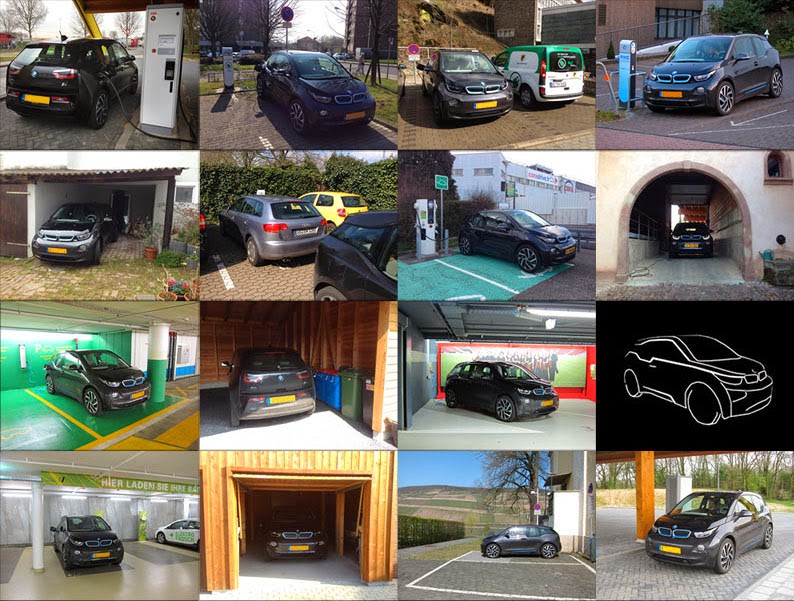
Back in February we featured Steven from The Netherlands as a Born Electric guest blogger. At the time he mentioned to me that he was planning a road trip with his i3 REx that would take him on a fantastic journey from The Netherlands through Germany and France to the final destination of Switzerland. The funny thing is, I almost was able to meet him along the trip because I was actually in Switzerland the week before he arrived and my wife and I even spent an afternoon at the same lake in Zurich you see pictured below! In any event, once I heard Steven was about to engage upon this 1,100 mile road trip I asked him if he wouldn't mind sharing the details here once he returns and he was kind enough to do so. I get a lot of questions about the range extender, and many people want to know if it is possible to take it on a long trip. This post doesn't answer every question, but it does give some insight into how the car will perform on sure an extended road trip. I haven't read any story of an i3 doing a road trip over 1,100 miles yet, so this may be the first account of such a journey.


Travelcompanion: i3

OK, so we have this i3. It was, and still is, marketed as a city slicker. The question arises: is BMW underestimating itself ?

To begin with the conclusion: yes and no. It will go outside the city and beyond, with quite an aplomb at that, but its driver needs some commitment and perseverance to get there. As stated by Tom elsewhere: it is not a go anywhere, do anything car. With a normal to brisk driving style, it excels on local trips with perhaps a charge or two along the way. But when taking it easy, tourist style, it can haul you much further than your cities limits.


Once you get used to its unconventional lines the design grows on you.
Our i3 in the Appenzeller mountains.
The commitment starts with a careful planning. Call me a nerd, but I rather like planning a trip in detail, time allowing. However, the limited electric range did cause a little frustration. Frustration about not being able to reach the higher alpine passes in the six days we reserved for this trip. When pushed, we certainly could have done it, but in the end we opted to make the journey itself the goal.

The first hurdle is Europe not being the United States of Europe. Different plugs, different chargecards, you name it. Totally unfunny. Luckily, one of Hollands energy suppliers is owned by RWE, a large German energy supplier, so we could apply for a German charge-ID. You’ll need an app on your iPhone to start the charger, but that’s ok. For France and Switzerland, we’re out of luck. A lot of local/regional initiatives, so charging possibilities are limited to free chargers or, in Switzerland, chargers mounted in parking garages where charging is complementary or at a cost, payable at the checkout machines. And these have to match our Mennekes plug as well.

As you’ll understand, planning took a while, especially while I was not only looking for locations to charge, but also for roads worth driving and places worth visiting while charging. Not much fun to be stuck on an industrial estate for three hours… In the end, I planned our trip so that it would take us three days to reach Switzerland, leaving much of the motorway behind after crossing the Dutch border. Slow tourism, like our parents did with their 2cv, before Europe was shrunk by the proliferation of the Autobahn.

Departure

Smoothly gliding away, to not disturb our neighbours, is uneventful in itself. EcoPro is on, but so is the heat, for it was freezing during the night. Damn, we’ll need those electrons! Well, not entirely, to be truthful, for our first stop is at a 50 KW fast charger. The residual charge doesn’t seem to matter much at the fast chargers’; it’ll charge to 90% in 30 minutes anyway. But there seems to be a catch. We left the charger with ~94%, but the charge dropped right down to 86% in a matter of minutes. Something we have observed more than once after a fast charge. A pity in this case, because the next station should have been reachable with a margin. A margin worth having, for we were able to reach our designated charger with only 5 km (3 mi) on the clock. But hey, it was supposed to be an adventure !

This is the point where I have to admit we are driving the i3 ‘chicken version’, with the little REx in the boot. The upside: unlimited mobility. The downside: REx wakes at 5-6 km, no matter what. So we were at the threshold of failure to do the E-thing, and that only two hours into our journey! But we made it. We had lunch, walked the totally unremarkable town, takin’ it easy as promised, until the car was charged enough to reach our next goal. The ability to use your smartphone to monitor the car is invaluable.

The next goal: Monschau. A quaint little town, picture book stuff. Flocking with tourists of a more advanced age when in season, it is actually very nice when not. Coffee, apfelstrudel, you’ll get my drift how we passed the time.

Chargetourism: Monschau
With enough inside us and in the i3, off to the next charger. A short charging session of 32 minutes at 32 amps in Daun was all it took to take us to our hotel in Bernkastel-Kues. Again a picturesque village, this time with a larger river (the Mosel) and an ancient castle on the adjoining mountain. And the best news: we have entered the wine region, so the i3 was not the only one being replenished :)

At this hotel, we had the first experience of the friendly cooperation we would encounter along the way. We were fully prepared to have to drive the car to a charging station nearby and to walk back, but the hotel owner promptly offered us a spot in his yard where we were able to plug in under the carport. Sweet.


France

Day two took us through Germany to France. Our second hurdle: the designated electrospots in Saarbrücken were occupied by gas-burners! A Zoe was already double parked and charging, but i3’s cable is not long enough to do this. Damn. Now what? Time for friendly cooperation example #2: the receptionist of the adjoining offices came out to ask us if everything was ok, noticing of course it wasn’t because of me standing there with a large blue cable in my hands, looking lost. The solution was easy: one of the owners of the damned vehicles didn’t mind to take a hike, so we could charge, albeit with a little delay. The upside: the German owner of the double parked Zoe turned up, so we had an opportunity for a nice conversation about the future of the world.

Charged and fed, off to France we went. One possibility to charge with no alternatives. Gold or bust! Golden it was. Free of charge as well. Very good of the Cora supermarket to lure crazy dutch electrotourists to their store :) With enough cheese and charge, we took off through the Alsace, an area we always quite enjoy for a lot of reasons.

One of the reasons is that it has some nice drivers’ roads with not to much other people on them. We already enjoyed some nice, but not too quick, driving in the German Eifel yesterday, and the Alsace didn’t disappoint. Nor did the i3, so it is time for some car stuff, for this is supposed to be a car blog last time I checked….

Like!
I like to start with some downsides here, so I can end the paragraph on a positive note. And I will lift a tip of the vail: it is a very positive note. But first: the grind. Although visibility all around isn’t exactly bad, the car is difficult to oversee, so it takes more practice than I’m accustomed to, to position the car in exactly the spot on the  road you want it to be when driving spiritedly. It is growing on me, of course, but it is still not an intuitive process. I guess it has to do something with not seeing any of the nose or any other external part and the overview you miss in tight left hand bends because of the drivers side A pillar. I am still not used to have to look through the side windows to oversee that tight left-hander. Then there is the steering. Once accustomed, it is excellent and precise, but so direct that you’ll have to handle it smoothly if you want to impress your co-driver with your cornering style. And the last grump, which is really a very small niggle: close the rear doors firmly before doin’ the bends, for the warning signal for these is on a hair-trigger. (Tom's note: I have had other i3 owners tell me this also. If you don't close the rear door firmly, the "door ajar" light can light up while you are driving. It's in no danger of opening, it's just an oversensitive trigger than needs to be fully depressed).

Now for the gold: Do we enjoy it when it is going where no i3 has gone before? Oh yes! Yes! It is fast and nimble, which is good in itself, but it is the smooth as cream comfort that is the hammer. The suspension is firm, you already know that, so that is not the unique selling point comfort-wise. It is the easy, creamy-smooth instant power, the effortless recuperation, the relaxed one pedal driving that makes it so enjoyable to drive on your winding Alsacien roads! Take it out, that i3, if you have it, I’ll think you’ll enjoy it as much as I do !

With plenty charge left, we arrived in the quaint Alsacien winemakers’ town to fill up us and the i3 again at the B&B, a winemakers establishment. My advice: go there, drive the roads, drink the wine. Just do it in that order!

Switzerland

Not much to tell about day three, this being a car blog. Only that the leg to Basel was 106 km, mainly motorway, so we kept it between 90-100 (55-60) in the right lane to reach our destination with some electrons to spare, for alternative usable charging stations are sparse around there. With plenty of charge to get us to our next B&B we left sunny Basel and the river Rhine. 40% charge was a luxury I could enjoy for the 10 km (6 mi) drive to and fro from the B&B to the evenings’ restaurant later. This little drive was, besides enjoyable, also a good reminder for me to keep driving carefully during the day to make the most of our E-range, for the battery had only 16% remaining when plugging back in at our B&B at night. Do the math if you like. In our defence, we had the heat on on the way back…
Goal #1: Make it to Zurich using only electric power
Being already very pleased we reached our goal of getting to Zürich fully electric the next day, we set a new goal of reaching at least 1000 km (621 mi) of uninterrupted E-use. After a very enjoyable day in Zürich and at our friends there, totally uninteresting for you i3 enthousiasts, we started drifting in the ‘back’ direction on Saturday afternoon. With one final Swiss charge in St Gallen remaining, we took the i3 through Appenzell. Some mountain roads, not the most spectacular passes, but still sporting brisk climbs once more affirmed our belief that the i3 is a very nice car indeed. It's hard to keep your foot off that throttle :-)).
Goal #2: 1,000 km all electric
Then we reached the dreaded point that was looming in the planning all along. It was not the Swiss border which we passed without ado, it was the point at which the beast in the back had to be awoken. Time for a little car talk intermezzo.

REx

I can understand that a lot of people question the execution of BMW’s REx solution. On the risk of repeating myself: I think they did a wonderful job, for it feels nearly sinful to start the REx after driving on electrons. So smooth. So quiet. So soothing for the conscience. You really get the feeling of doing the wrong thing when firing up ye olde’ ICE. And this is how it should be. It is an electric vehicle extended, mind you! Besides from this, the little bugger does its best to keep you mobile. We here in Europe have it easy, sorry about that American brethren, for we can engage REx at will, so we don’t have to motor through towns and countryside, but we can plan our  REx extension to happen anywhere along the way. The added bonus is of course that you can keep a nice safety cushion in the battery to get it up that Autobahn-slope, although it has to be said I was quite taken with the ability if the REx to keep up the battery when doing 120 (75) on the cruise with A/C to boot. On those not to steep but long slopes (climbing ~250 meters in ~35 km (~820 ft/~22 mi)), the battery level drops a little bit, of course, but I would say that a cushion of around 5% could just about, or just about not, suffice for most journeys. One thing I have noticed is that is seems that the car allows for a bigger battery-drift if you engage the REx earlier. One advantage of this is that it doesn’t have to run at top revs all the time to keep the state of charge on the small marker on your dash-display. Once the state of charge is low, it works very hard to maintain the 5% and prevent very low charge. To end this intermezzo about the REx something on fuel consumption. Exactly economical it is not. Doing 120 (75mph) on cruise gives you something of 15-16 km per litre (35-38 mpg us). Not too bad, not great. Taking 10 km (6 mi/hr) off the speed does wonders to this consumption however, but we kept it at 120 (75) where allowed.
Driving on the Autobahn: Speed kills - consumption rate that is!
A relatively uneventful 628 km (390 mi) later: home. We made a little touristic detour along the Rhine, which we used to recharge a bit during lunch, so we could cruise the 50 km (31 mi) of Rhine-borders in tranquility, and we recharged again at our nearby fast charger to make the last stretch on electricity before parking the car at its homespot with a feeling of well done planner, well done driver, well done little car. It is not perfect, but it is loveable all the way. And it’ll go further if you dare it…
Final stats of the journey
Map of journey


1780 km (1,104 mi), plugging in 16 times during the trip
Approximation of route travelled (source: Google)


Disclaimer - We have undertaken this trip and I have written this article on a strictly personal basis. I am not affiliated to BMW or anyones business mentioned in this story. Please mind that everything you’ve read here are my/our personal experiences and opinions and should be treated as such. Also, bear in mind that the English language is not my native one, so be patient if I’ve made some mistakes or used clumsy language. Any offence is unintentional.

Regards, Steven


A postcard from Steven to summarize his charging efforts along the way!

Monday, March 10, 2014

Born Electric Guest Blogger: Meet Jon From Norway


So Far we've had Andy from the UK , Hil from Holland , Toni from Belgium, Jan From Belgium, and Steven from the Netherlands.   We'll now be traveling to Norway to see what Jon has to say about his Solar Orange BEV i3.

Hello, I'm Jon from Norway and I was Born Electric on February 13th.

Until now I’ve been "partly electric" by cycling once a week (not in winter) to work with an electric bike. It's 17km each way and I've done 1000km in total. Living in the southwest of Norway, in Sandnes and working in Stavanger, nearby.

Electric or hybrid?

I first started looking for a hybrid vehicle that could go electric to and from work. Toyota and Lexus could just go a few kilometers in electric mode which wasn't enough for me. Then Volvo came up with one, but it was too expensive. The i3 was the first all-electric that I found interesting. In the past two years the most we have driven at any time was about 100km. If we need to travel longer than that, we go by air. After reading just about everything I could find about the i3, I decided to sign an informal agreement to buy one on July 11. Since then, Audi and VW have announced a few interesting hybrids, but the Norwegian tax system gives the all-electric cars some advantages (at the moment). That meant the all electric BMW i3 is actually less expensive then the competing hybrids, plus it gets toll free passage and is free on ferries!
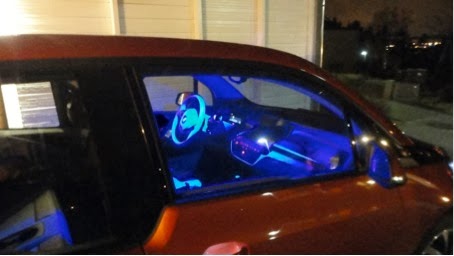
I like the blue LED interior lights when you lock or unlock the doors. You can also change the color if you don't like the blue
Buying it:

In October, BMW put an i3 in front of the Oslo Marathon to serve as a pace car. The BMW shop Bavaria in Stavanger lent it for a day and had it on exibition in town. I went there, took a glance, and felt in love. Unfortunately the salespersons knew even less than I did (Hi Tom, It’s the same mess in Norway!), so I spoke with two engineers that came to look at the charging system. Together we agreed that BMW needs another type of way to sell these electric cars. Speciliasts that have been properly trained for these unique vehicles. My experience earlier was that coming in to the BMW car shop speaking Oslo dialect got them to believe that I worked with Statoil and was looking for an expensive model. The salespersons focus on status models with big engines is not suitable for electric cars! These cars are different and the sales processes should be different as well. When i3 was introduced in November, I took it for a spin and was convinced. I was about the 50th person to sign a contract out of the 550 in total in the southwest of Norway. After seven long months of waiting, I finally have it!

My son and grandson like the i3 too!
Driving it:

It is a pleasure to drive! It is fast when you need it, yet with smooth and easy ride. Small and quick in town and with an impressive turning radius! Many Norwegian families have two cars because both parents use a car to come to work and the i3 can be a perfect second car for many of them. Quite often they will have a large car to go to their cottage in weekends. However from now on, the second should be all-electric like the i3! Moreover, for some of us it is the primary car, the one that gets the most use. The one foot driving is perfect! In the morning rush, I used to step on the brake pedal hundreds of times to avoid crashing. Now I just regulate the speed by the accelerator pedal. Even better, I go into the line of cars on the motorway and turn on the adaptive Cruise control. It's possible for me to travel the whole 15 km on the motorway just steering, not touching the any pedals! (Try that, Tesla!) I have a very good second car, a Saab 9.3 automatic, but I will now use it only if we decide to go by car to Oslo (500km, We have only Japanese fast charging system here now) or if I need to fetch something with a trailer. Last week we went to visit some relatives in the Archipelago north of Stavanger. The car did fine on the 80km drive, even with 5 degrees Celsius and strong winds. I was worried about the distance and how much air conditioning (heating) I could use, but was relieved when the car showed 55km to go after driving the 80km. Since the i3 is a tall car, strong winds do affect the steering more than I am used to, but it is not a big deal once you get used to it.

Perfect choice?

As a city car, I believe the best choice for the i3 is the all-electric car version now. Agile, quick and fun to drive. I like the narrow tires because they will not float in snow and they will not follow tracks in the asphalt. Norwegian roads have often tracks from cars with studded tires. The i3 REx would definitely make my range anxiety disappear, but here in Norway, it is too expensive because of the special tax system. To have the newest in security, you must add much of the extras BMW provide!  I paid 36% extra to get the essentials! (Tyre Pressure Monitor is free). I believe i3 is the only all-electric car with adaptive Cruise Control. That is a great, but soon  the electric VW Golf comes with it as a standard feature! Relative to the range anxiety, both Audi A3 and VW Golf comes with 204hk hybrid cars that uses 0,15l/10km! If BMW does not come up with wider range of electric cars, or hybrid 4x4, then VW-Audi will achieve their European goal, being the leading automaker here, also in electric and hybrid cars. As for the sound system, the car is a virtual concert hall with the Harman Kardon loudspeakers. I have a lot of music stored on the hard disk in the car. To listen to quiet parts of classical music without disturbance from the petrol motor is perfect. The extras are from the ordinary BMWs, and suits the i3 well. To give i3 the right premium feel along with the rest of the BMWs, I think you need optional equipment like adaptive Cruise Control, stop and go and Harman Kardon loudspeakers. However, as said before, these features do cost a lot! In Norway the base i3, the Leaf and Golf cost about the same without optional equipment. For me, i3 wins even though you do not buy optional equipment.

Two practical things about the i3 that I'd like to recommend: Floor mats in white velor are nice to look at, but not to use in winter. Also do not put the electric cables under the bonnet. The wet environment might damage it, they said. Therefore, I recommend using a waterproof bag for them like I do.

Saturday, March 1, 2014

An Aerospace Engineer from the UK Compares the i3 and the i3 REx


Lucas flying formation in the Crimea
Lukas Willcocks is a member of the BMW i3 Forum and when I noticed that he posted about having the opportunity to take both an i3 and an i3 REx each for 24 hour test drives I asked him if he wanted to offer his thoughts and comparing them here. What I didn't know was that Lukas is an aerospace engineer. A few of my friends are engineers and the one thing I've learned about them is not to ask a question about something without expecting an answer that involves thoroughly explaining every aspect of the subject. Well, I found Lucas is not very different from my friends! :) His response was about three times as long as any post I've ever put up here and below is actually the condensed version! Warning: We're going off into technical geek land here folks! Special thanks to Lukas for the time and effort he put into this guest post:
To REX or not to REX: 24h with the BMW i3 BEV and another 24h with the BMW i3 REX:

Greetings from darkest Lincolnshire in the English Midlands. Winter this year is mild but very very wet and windy! Educationally, my background is in aerospace engineering but long before that I helped my father fixing old Land Rovers in the Kalahari and later Fiat Twin cams and VW GTis in the EU. I'd always found rally and race cars exciting and in recent years had the privilege of racing in historic motorsports with a 1969 Lancia Fulvia HF.

Colin Chapman (of Lotus racing car fame) is quoted as saying to his engineers “add lightness!” In fact the quote is from Sir Geoffrey De Havilland who gave the world the amazing wooden composite Mosquito WW2 fighter bomber- a machine that could leave fighter aircraft for dead. He also pioneered the first Jet Airliner the DH Comet 1: http://en.wikipedia.org/wiki/De_Havilland_Comet

Aerospace is about efficiency and optimization for specific roles. Whatever the debate on the environment, the world is attempting to move towards more sustainable living. Only 8% of the planet is suitable for arable farming and we all hate traffic jams. Conurbations are increasing at an alarming rate. My old home of Gaborone Botswana had just 40,000 people in the 1970s – now it it has well over 250,000. That country (the size of Texas or France) had 10 miles of tarmac road. Now it has the Trans Kalahari highway!

No cyclist or pedestrian likes petrol or diesel fumes. Electric cars are seen as a way of improving air quality in built up areas. That's all well an good as long as folk don't claim they are emission free vehicles! Most countries still rely on coal fired power stations and acid rain and CO2 is still produced when an EV is used. Even California is not 100% Solar PV / Wind farm dependent.

What is the most efficient means of getting from A to B? An interesting question and much depends on the task – is it to transport 40 tonnes of produce to market 1000 miles away or 2 miles to the grocery store to pick up some tomatoes for lunch? I recall a study that said even cyclists put out at least 15g/km CO2 based on toast consumption!

Intro over!

My thanks go to Hamish of BMW Soper in Lincoln UK who provided the i3 BEV in white which was fitted with lots of toys! And also to Chris Whitmore of BMW Statstone Derby UK for the loan of the grey i3 REX.

So how did the BEV compare with the REX?

That is the ultimate question on most potential owner's minds. Interestingly both cars when fully charged used the same amount of energy on the 29 mile commute to work. The BEV was quick but it's advantage over the slightly heavier REX was not noticeable in normal use.  Both cars had the same tyres front and rear so there was no Cd advantage for the BEV either. Unless you go to the Drag Strip regularly, I very much doubt any driver would notice a difference between the BEV and REX in acceleration terms. If anything the REX felt a little more planted in the corners but this may have been subjective. The rear motor/RWD layout allows far more steering angle than a regular vehicle so the turning circle is very tight at low speed. In muddy conditions it is possible for the traction control to give up and the tail does wag a little if you are too enthusiastic with the go faster pedal.

The biggest change is when you get down to around 6 miles of range. In the BEV there is mild panic even in Eco Pro Plus mode. In the REX the motorcycle engine kicks in with an annoying drone but it is not really noticable above 40 mph.  Some were concerned about speed restriction reports when the REX gets down at lower battery charge levels. I tried 0-50mph max acceleration and this seemed unaffected but there was on screen advice to go easy on the throttle pedal to enable battery charge level maintenance. It could well be that 70 mph uphill on a freeway would not be sustainable at these lower charge levels. That said,  my return journey was with REX activated manually at around 30% SOC. It did not maintain it precisely but achieved around 27% SOC over the 29 miles. Refueling was done at the same Shell station with same grade of petrol - tank was topped off both before and after commute. Economy on REX is not that great but it is really there to get you home or to nearest fast charger.

My guess is the battery in a REX will be in a far better state than that of a BEV after 3 years of similarly hard use. The damage associated with running the LiON batteries to an absolute minimum are more likely to be avoided by the car that maintains charge at low levels.It should also be noted that when the doors are unlocked the charge goes down whether plugged in or not because displays and system heating are activated and run off the main battery.  This might be fixed by a BMW phone app for users who wish to configure for a trip whilst charging. Showing off all the gizmos to your work colleagues will also deplete charge! 

Overall I like the purity of the BEV and only wish it could better 60 miles in mild winter commute. If it could do 100 miles at 60 to 70 mph I would buy one right away. As it stands if committing to an i3, I'd have to go for the REX and downgrade on the options list.
Now for some thoughts on the i3 in general: 

What can we compare the BMW i3 with? Existing cars have come a long way since Henry Ford. On the other hand the past decade has seen an explosion in ULVs (unsuitably large vehicles) sold to consumers of a “super size me” culture. Now I am all for the old Range Rover V8 doing 16 mpg through deep Kalahari sands where a Ford F250 got just 8 mpg. However for the grocery store run?
That might be acceptable in Arizona but on cramped narrow British roads with passing places in hedgerows or London's residential road width restrictors? Bigger normally means heavier and less aerodynamic so the term gas guzzler still applies. How is it that in 40 years fuel consumption has not really improved significantly? Part of the answer is heavier structures and crash worthiness regulations but that's often an excuse. Take the Fiat X 1/9 2 seater 1970s mid-engine sports car – it featured 50 mph impact bumpers and roll over protection for the US market – they even rammed one with an AMTRAK ! It passed but then the Feds reduced the regs and Fiat lost out. However that small car was tough (apart from on UK salt laden winter roads) yet still much lighter than today's machines: http://www.sportsvogn.no/x19reg/story.html

A few visionaries still exist. VW developed the 3L cars – 3 litres of fuel for 100 km of travel. They produced the shortened Polo and called it the Lupo 3L with magnesium and Aluminium panels. Audi developed the all aluminum A2 which many have cited as an influence on today's BMW i3. The 3L version of the A2 was designed to carry 4 German sized adults and their luggage from Munich to Turin over the Alps with minimal fuel cost and low emissions. It had a Cd of just 0.25 – the same as the original 2 seater Honda Insight hybrid and weighed just 855 kg.


This has been my everyday transport for some 190,000 miles over the past 12 years: http://www.greenconsumerguide.com/audi_a2_tdi.php Sadly the car was poorly marketed compared with the less efficient Toyota Prius and productionceased in 2005. But not before an H2 and electric variant were prototyped. In 2010 DBM Energy claimed their modified Audi A2 could travel 375 miles at 55mph on batteries alone.


Sadly the factory and prototype burnt down.

VW have moved on into the extremely expensive ECO car with their impressive XL1 – but it's no longer a Volks-Wagen (people's car) at £100k !


Others have compared the i3 to Tesla. A bit like comparing a 1 series with an Aston Martin.

This review will look at basic everyday practicality and make some suggestions for BMW's further i3 development.....


External Colour choices:

Not a lot of choice. Mostly greys, silvers and one for the Dutch : orange. I don't mind the
contrasting black panels. One dealer suggested the i8 Protonic Blue might become available next year.

The biggest downside if you want orange is the extra you have to pay to upgrade the interior. Someone should tell BMW to have a look at Irn Bru (Scottish Soda – orange, black &blue can work!). Not such an issue in USA.

Interior space:
Many reviewers have posted that the i3 has an airy feel – at least from the front seats. I would agree that the large sloping front windscreen and uncluttered dashboard appears to offer more light and the high seating position reduces any bathtub parallels by giving a more commanding view of the road ahead. However, whilst the i3 is around 15cm wider than the A2, in the rear it has almost 4cm less headroom, 20cm less foot room and just under 7cm less elbow room. The larger rear side windows help to mask the latter somewhat.

The white i3 BEV had a white LOFT interior – nice if you never drive in the real world. The white carpets soon became muddy grey brown! The REX had the standard interior which was very practical.

I like the futuristic flat screens that appear to hang in space over the dash.


Whatever your view on the construction material, the anti reflective properties of the dash work well with the black bonnet rather like a 1960s Rally car.

The driving position is very comfortable and has a good degree of adjustment. The seat height shift is a little awkward compared to rival cars where body weight has to be lifted on the steering wheel before raising.

The seat heating is a very worthwhile option for winter driving and means you can save energy on interior heating.

Side bolstering of the front seats is minimal. Had the car been designed with conventional rear doors and without forward tilt on these front seats, maybe BMW could have gone for a fixed back sportier option like a Recaro Pole Position (just 7kg!).

Load space:

One disadvantage of RWD with rear Motor placement is the much high than normal load area and reduced volume.
(litres seats up /litres seats down)

i3: 260 / 1100 litres
A2: 390/1085 / and approx 1400 litres with rear seats out
A3 Coupe: 365 / 1100 litres
A3 Sportback: 380 / 1220 litres
A1 Coupe: 270 / 920 litres

Quite a bit of space is taken up with American sized Soda Cup holders between the seats!

Weight Saving:

BMW has made much about the lightness of the underlying CRP structure on the i3. They are to be congratulated for bringing this to a sub £26k (base model with £5k UK grant) production car.But it is still a heavy car even making allowances for the EV battery pack.

One wonders whether 19 or 20” wheels are more about style over substance – certainly a larger diameter spinning mass has a greater effect on vehicle dynamics. It would be interesting to know what each wheel design/tyre combo weighs.

Areas where lightness could be added:
1. Make it a 3 door or go for conventional rear doors with CFRP B pillar.
2. Go for 1 front wiper blade with full sweep. Remove rear wiper mechanism and install
better rear tailgate with aero screen cleaning. (NB: the front wipers DO NOT sweep up to 90 degrees so there are a couple of unswept patches either side at eye level).
3. Make rear seats removable like briefcase design in A2 and front seats fixed back like Audi TT Quattro Mk1.

5 Doors or 3 door with Access panels?

In terms of accessibility we have already seen reviews of the difficulty in releasing rear occupants with driver or front passenger in place. The suicide rear doors are a design statement more than a practical solution to rear seat entry/egress. Such an arrangement in a UK Supermarket parking space with an SUV either side, it could get too tight to let the kids out of the rear seats. In some ways a 3 door hatchback or Coupe might have an advantage, although those front doors tend to be longer. It seems odd that the designers made the front seats forward tilting and indicates that a 3 door option may have been in mind.

Some commentators have made comparison with the Mazda RX8. In both cases these sucide doors have had to be strengthened considerably and fitted with larger closing mechanisms and hinges to cope. From a weight and energy saving perspective this is a little absurd. Matters are made worse if a child seat is fitted in front without ISOFIX. Note the weight limit is just 18kg (40lbs) for an ISOFIX attachment so heavier children will require the seat belt attachment. This makes it impossible to open the rear door on the pax side if the child seat is up front.The deeper rear windows are good for rear seat occupants but do not open – not even to a vent position. Again why bother with rear doors? Make it a 3 door Coupe like the orange prototype or offer a CFP B pillar / Avant version with normal rear doors and hidden handles ( a la Alfa Romeo 156).

Aerodynamics - What a Drag!

The i3 has a closed front grill / kidney emblem and commendably flat under tray free of the usual incursions. But for an ECO minded car it is somewhat surprising that BMW did not strive to improve the Drag Coefficient or reduce the frontal area of the i3.

If you never go over 40 mph (London UK inside the M25) this isn't going to affect you. But most London workers live outside due to ever spiralling house prices and will likely need to use the Motorway (Freeway) network. Greater aerodynamic efficiency (and hence lower battery consumption) could have been achieved by replacing the BMW X5 like wing mirrors with VW XL1 rear view cameras or at least more compact examples. The Cd is 0.3 (about as bad as a 1992 Toyota Camry or 1993 Subaru Impreza). The i3 is much wider than most pure 4 seaters and the MPV styling and battery floor makes it quite tall. Frontal Area of 2.38 m2 x 0.3 results in a CdA of 0.714.


Compare this to a 2001 Audi A2 1.2 TDI : CdA 0.544 or 2013 VW XL1: CdA 0.279.

At 100km/h (62mph) the i3 BEV creates 326 Newtons of drag. The REX model a little more at 336 Newtons. The A2 a mere 257 Newtons.

More meaningful to the average punter is BHP absorbed by drag. Here we are not considering the drag from the drive-train / single gear or tyre friction and this is for a flat road with nil wind.

At 40 mph the i3 consumes a minimum of 3.33 BHP (2.5kW) in drag alone. Not a lot! But accelerate to 60 mph and it goes up a factor of 4 to 12.5BHP (9.317kW). Get on the freeway in Montana or de-restricted Autobahn and at 93 mph the i3 requires 42.14 BHP (31.44 kW)!

It is no wonder that i3 test drivers have noticed a massive reduction in range when driving on faster roads. If you add in tyre resistance, wheel well turbulence, and a less than optimal gear ratio (optimised for acceleration rather than cruising then expect about 60 mile range from a BEV and a bit less all electric from the REX).

What if BMW had optimised just the Aero side?

40mph:
A2: 2.54 BHP(1.894kW),
XL1: 1.30 BHP(2.54kW)

60mph:
A2: 9.52 BHP (7.10kW)
XL1: 4.88 BHP (3.64kW)

93 mph:
A2: 32.1 BHP (24kW)
XL1: 16.5 BHP (12.28kW)

The i3 could be improved by careful modification of the front profile (which could include improvements to pedestrian safety), an extension or redesign of the tailgate and a longer rear spoiler, vortex generators at the rear (perhaps incorporating the trademark aerial) and more ducting air dam style under the car to improve wake and add almost drag free down-force. The door alignment and rear wheel arches could be improved to lessen drag.


Noise:

The i3 internal SPL is actually about 2dBA louder at 50 mph than the diesel Audi A2 due to wind noise. But at lower speeds the ICE can't compete (except with Start Stop at the lights!).

Driver Technology:
The BMW i brand is all about connectivity and city mobility. This test drive did not spend much time in the City. It is not possible to test the iphone/Android app without making a purchase as it is linked to the vehicle's VIN number. I was able to link my phone via Blue Tooth and play music through the radio functions. This worked 90% of the time. Both cars had standard audio which is of reasonable quality. The other 10% there was electronic signal distortion.

The layered menus were not as intuitive as a touch screen app. The iDrive handwriting recognition didn't work for me as a Right handed scribe in a RH Drive car ! My other cars are LHD!

The start up procedure could be simplified. It's not a get away car! Unlike the A2 that tells you to put your for on the brake pedal before start, the i3 makes that assumption. The electronic handbrake took some getting used to but when trusted it seemed to work OK even on hill starts. NB the CFRP Alfa Romeo 4C has a traditional handbrake and is the lightest car in it's class.

Unlike other EV manufacturers the battery regen mode is all about the accelerator pedal. The sweet spot for freewheeling downhill is hard to find with the small text on the Tacho indicating minimal kWh/100km use. This could be corrected with a Head Up Display or peripheral coloured lights to aid the driver to drive more efficiently. Similar displays tell pilots about optimum wing angle of attack in flight.

The white i3 BEV had all the goodies in terms of rear view camera and automatic parking. This worked well 4 times out of 5. The 5th was the same spot as the 4th but for whatever reason the car refused to park itself once it found the spot. One issue is the position of the camera which is right on the rear bumper (fender) where it gets covered in road muck. A better spot might be behind the rear glass within the wiper's swept zone.

The large centre screen was a delight if a little distracting on the move. It is especially good in the rear view camera mode (with a clean camera!). But you must still scan between screen and real world to avoid pedestrians who can't hear the i3!

There is no SOC on the BEV which is a shame. The REX has it hidden away on a “hold state of charge” menu.

The vehicle pre-conditioning menu takes some finding but worked on both BEV and REX. It's important to realise the extra electricity you will use to get the car up to temperature in winter. I set 16 deg C for an 0715z departure time on both cars. The mistake with the BEV came when I tried to charge at work using a 13A socket. The car did not charge because the menu had a timer setting (for cheaper home night tariffs). In the end I managed to cancel that and got just an hour's worth of charge.

Breakdown cover:
The i3 has no jack, no spare wheel, no wheel brace. Back in 2003 I learnt the hard way that tyre gunk doesn't work as advertised. In fact I had bought a full set of winter wheels and tyres for the A2 but had left these at home on the daily commute. One of the skinny Bridgestone B381 Eco tyres gave up the ghost at 60 mph. There was no drama and no wheel damage but it was a busy road . Had I had a spare I could have used the underfloor tool kit and Alloy jack to get back on the road within 20 minutes. Instead it took over 4 hours to get a recovery truck out and go home to change wheels.

The i3 cannot be towed in the conventional fashion and must be lifted onto a low loader! I would rather carry a spare. But 19 or 20” in that small boot (trunk)?!

In Germany a full set of Winter 19” rims can be had for 900 Euros. In the UK BMW are charging almost double! LED lights: The BEV had the optional LED headlamps for normal (dipped) use. This gave a pleasant blue / white light. The adaptability was not noticed on country lanes. Main beam was still halogen and no better than other vehicles. The mix of blue and yellow light is a little odd.

How does it drive?

Short answer: Very well!
In fact it is great fun to drive and the novelty of silent startup and acceleration to 40+ mph is superbly smooth. The downside of fun is the temptation to use the available torque. Only once did my free hand reach for a non existent gear stick! Yes I would have liked a second cog for more efficient highway motoring.
The bar graph (approx SOC indicator) goes down like fuel gauge in an English Electic Lightning!


For a newcomer to EVs it feels very odd to start moving in near silence. This requires even greater lookout and anticipation than normal in built up areas as pedestrians do not hear you coming. That is a positive aspect that should re-energise driver skills.

The acceleration is excellent – the REX was not noticeably more sluggish than the BEV. I spent most of the time in ECO PRO mode (with a maximum of 70 mph set for motorways). ECO PRO + was used to get from work to the dealer in Lincoln with a depleted battery. The car felt much more fidgety on the twisty B roads than in Comfort or EP. Perhaps the stability electronics and throttle/extra regenerative braking response has this effect.

Visibility from the driver's seat was better than expected and very similar to the A2. The driver just has to move their head around the thick A pillars when approaching junctions. The grip from the 155 front and 175 rear standard tyres is more than adequate for dry road cornering at speed. The rear tyres did struggle when there was a little mud on the tarmac and the traction control flashed on these occasions. Winter tyres offer a good 3 times the grip and much shorter stopping distances so it would be interesting to compare in winter conditions.

I was surprised that the BEV had 175 section rears and this may have added drag to match the REX. Apparently the REX has a slightly narrower rear track. Steering feel was good even if not direct (servo assisted). Narrow tyres bring steering benefits and
the turning circle impressed all who witnessed it. The cruise control was very good. Neither car had the lane keeping/auto braking technology.

Conclusions:
First off BMW deserves credit for bringing the i3 to market. It offers an alternative approach to EV design and manufacture. The blue sky thinking maybe went a little overboard in the style over substance department.

However, the looks grew on me. Even the cheap looking interior panels! The car drove far better than a car of this mass deserves. In practical terms it is not as good as it could be. BMW could learn a lot more from a similarly sized car built with practicality, ECO credentials, lightness and aerodynamic efficiency that is 15 years older. The aluminium Audi A2 (especially the 1.2 model). One thing they did far better than Audi was in marketing the i3 more aggressively like Toyota did with the Prius.

Improvments: If I were responsible for product development on the i3, for 2015 I'd introduce tat least some of the following:
1. Three door version like Coupe concept
2. Aero optimisation
3. Further weight reduction programme.
4. HUD option with SOC indication
5. More obvious ECO / Freewheel indication
6. More colour choice not linked to interiors
7. Lightweight Biodiesel or CNG REX options
8. More practical 5 door version with B pillar, removable rear seats and FWD to improve rear load space and traction in snow.
9. Better seat raising design.
10. Full LED lighting
11. RH iDrive for RHD and LH iDrive for LHD markets
12. Fairer winter wheel/tyre pricing
13. Better rear camera positioning
14. ICE FWD option without EV for long distance commuters in countries without decent electrical network.
15. Spare wheel/ jack options as alternative to tyre gunk.
16. Better Driver info menus
17. Better English translation of manual
18. Work with Solar PV controller manufacturers to offer old i3 batteries as storage and the likes of “Immersun” to offer Solar PV charging.
19. Encourage Fast DC network expansion in all markets – like FastNED.

Special thanks to Lucas for the in depth review!